
The AWS Certified Solutions Architect - Associate exam asks you to select designs that are secure, resilient, high-performing, and cost-optimized. The current SAA-C03 exam guide weights those four domains at 30, 26, 24, and 20 percent of scored content.
Read the official SAA-C03 exam guide before building a plan. AWS documentation is the source of truth for the current exam.
Week 1: Identity, accounts, and data protection
Study IAM policy evaluation, roles, federation, Organizations, service control policies, KMS key policies, Secrets Manager, Certificate Manager, WAF, Shield, and network security controls.
Practice separating authentication, authorization, encryption, and network reachability. They solve different problems.
Week 2: VPC and hybrid networking
Learn CIDR planning, subnets, routes, internet and NAT gateways, security groups, NACLs, VPC endpoints, peering, Transit Gateway, VPN, Direct Connect, Route 53, CloudFront, Global Accelerator, ALB, and NLB.
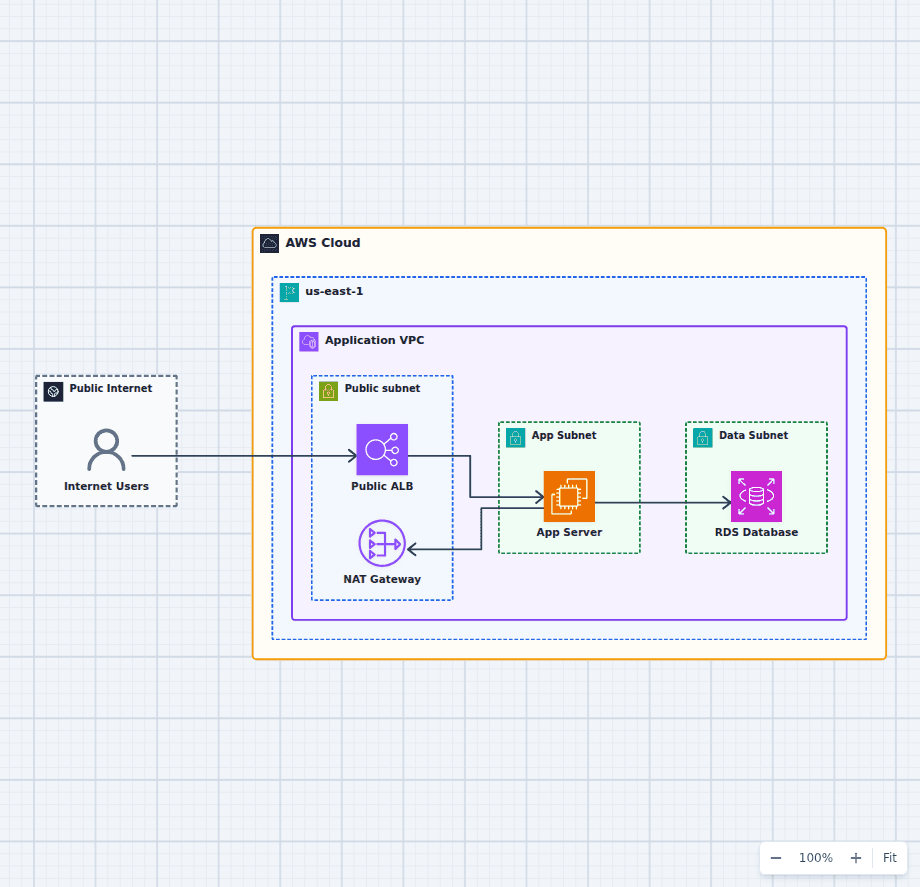
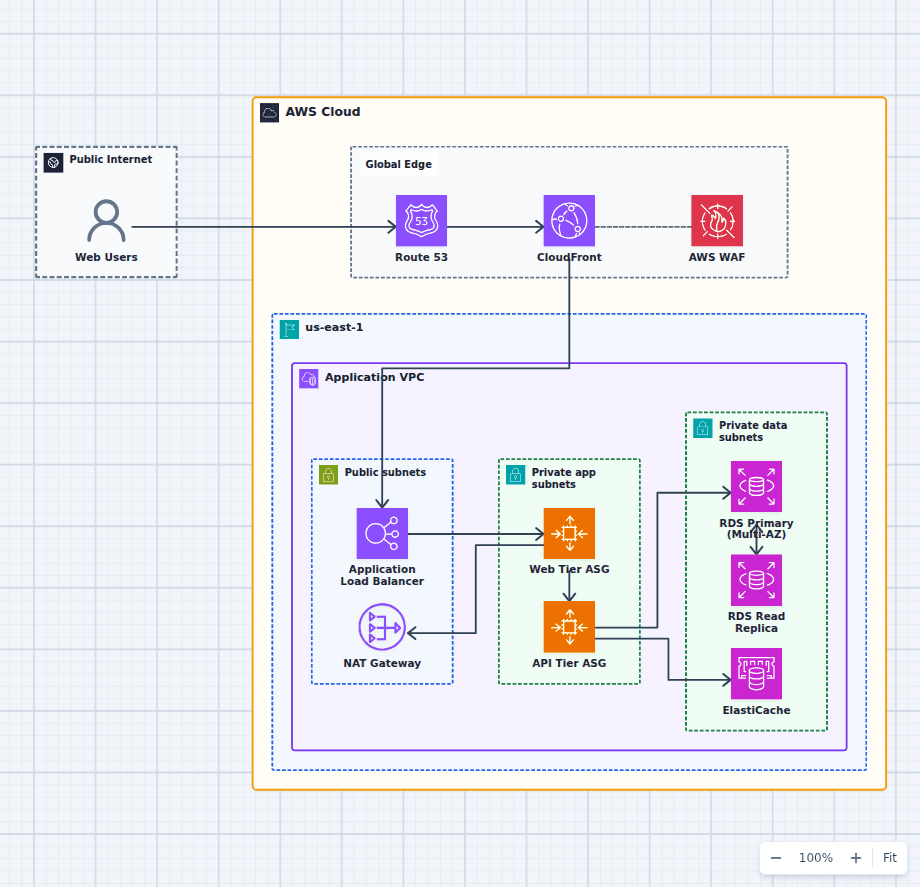
Trace the public and private subnet architecture and the hybrid Transit Gateway architecture.
Week 3: Compute and application integration
Compare EC2, Auto Scaling, Lambda, ECS, EKS, Fargate, Elastic Beanstalk, Batch, and Step Functions. Study SQS, SNS, EventBridge, and Kinesis with retries, ordering, fanout, and backpressure.
Use the EC2 vs Lambda vs Fargate guide and event-driven order architecture.
Week 4: Storage and databases
Know S3 storage classes, lifecycle, replication, versioning, Object Lock, EBS volume types and snapshots, EFS, FSx, Storage Gateway, DataSync, and transfer services.
Compare RDS Multi-AZ, read replicas, Aurora, DynamoDB, ElastiCache, Redshift, OpenSearch, and purpose-built databases. Study backup, restore, consistency, access patterns, and failover.
Week 5: Resilience, performance, and cost
Connect Availability Zones, health checks, statelessness, quotas, caching, read scaling, partitioning, asynchronous work, recovery patterns, and multi-region strategies. Then attach pricing models: On-Demand, Spot, Savings Plans, storage classes, data transfer, NAT processing, and managed-service tradeoffs.
The multi-region disaster recovery guide is a good synthesis exercise.
Week 6: Scenario practice
Use timed sets. For every scenario:
- Identify the hard requirement.
- Mark the workload type and current constraint.
- Eliminate services that violate protocol, data, availability, or operational-effort requirements.
- Choose the simplest answer that satisfies every stated constraint.
- Explain why the runner-up loses.
Build a decision matrix
Do not memorize that one service is "best." Record the condition that makes it best. ALB wins for Layer 7 routing. NLB wins for static IP and Layer 4 protocols. SQS wins for a pull-based durable work backlog. SNS wins for push fanout. EventBridge wins for rule-based event routing.
Hands-on work
Create and tear down a small VPC, ALB, Auto Scaling group, S3 lifecycle rule, Lambda queue consumer, and RDS snapshot restore in a controlled account. Set budgets first. Hands-on work makes configuration limits and failure behavior memorable.
You are ready when you can explain the architecture in plain language and defend the tradeoff, not when you can recite the product page.