
Solutions Architect Associate questions often provide several technically possible answers. The winner is the one that meets every requirement with the least unnecessary operational burden.
Scenario 1: Survive an Availability Zone failure
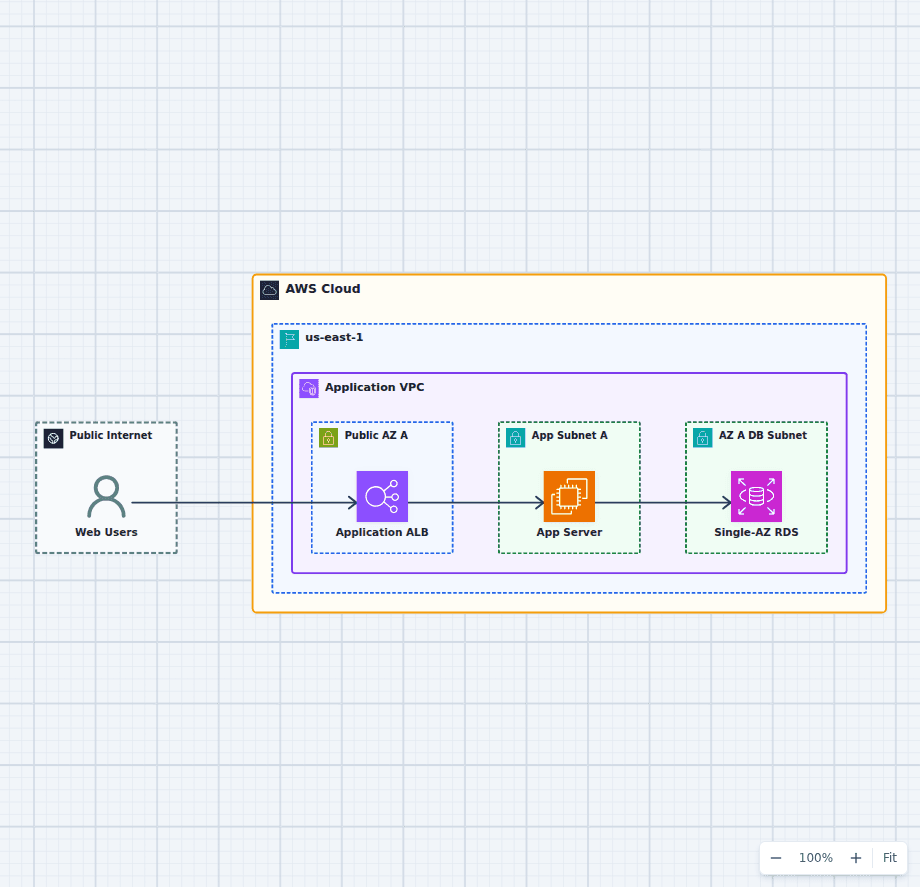
Use a load balancer across subnets in multiple Availability Zones, stateless compute with Auto Scaling, and a multi-AZ data strategy. A larger EC2 instance in one zone improves capacity, not availability.
Practice with the single-AZ architecture review, then compare it with the multi-AZ web architecture.
Scenario 2: Absorb a traffic spike
Decouple producers from consumers with SQS when work can complete asynchronously. Scale consumers from backlog. Set visibility timeout and dead-letter behavior. Adding more synchronous retries can amplify overload.
Scenario 3: Serve static content globally
Store objects in S3 and distribute them through CloudFront. Keep the bucket private to the distribution when production security requires it. Use Route 53 for DNS and ACM for certificates. EC2 web servers are unnecessary for static objects.
Scenario 4: Scale database reads
Use read replicas when a relational workload is read-heavy and can tolerate replica lag. Use Multi-AZ for availability, not read scaling. Use ElastiCache when repeated reads benefit from an in-memory cache and the application can handle stale or missing cache entries.
Scenario 5: Choose relational or DynamoDB
Choose RDS or Aurora for transactions, SQL, joins, and relational constraints. Choose DynamoDB for known key-based access patterns and managed horizontal scale. "Millions of records" alone does not require NoSQL.
Review the AWS databases comparison.
Scenario 6: Give private instances AWS service access
Use a VPC endpoint for a supported service when the requirement asks for a private path or reduced NAT dependence. Use a NAT gateway for general outbound IPv4 internet access. Do not assign public IPs to private application instances just to reach S3.
Scenario 7: Connect many VPCs and on-premises networks
Transit Gateway provides hub-and-spoke connectivity at scale. VPC peering can fit a small number of direct, non-transitive relationships. Direct Connect provides a dedicated connection, while VPN provides encrypted connectivity over the internet.
Scenario 8: Protect against accidental deletion
Use S3 versioning, lifecycle and retention controls, protected backups, and least privilege according to the requirement. Cross-Region replication can copy objects, but replication alone does not replace a deletion and recovery policy.
Scenario 9: Choose a disaster recovery strategy
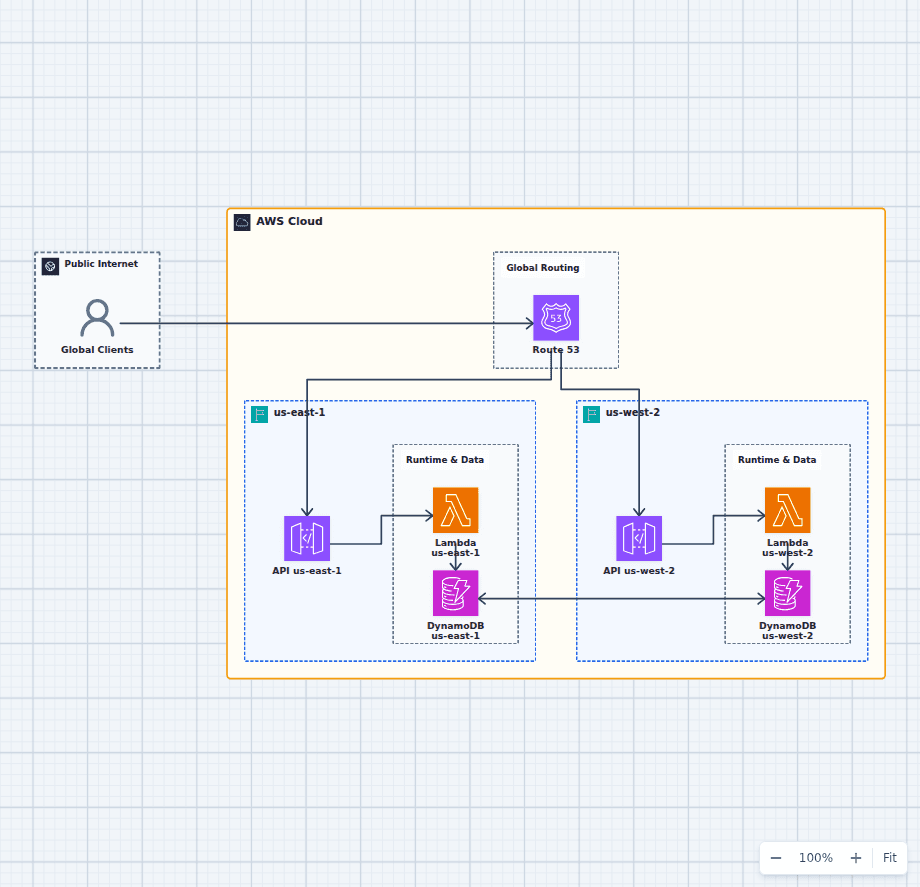
Match backup and restore, pilot light, warm standby, or active-active to RTO and RPO. The most expensive design is not automatically the right answer. Read the multi-region DR guide.
Scenario 10: Reduce cost without redesigning everything
Stop idle non-production instances, right-size from measured utilization, use commitments for stable baselines, use Spot for interruptible capacity, move objects through S3 storage classes, and avoid unnecessary cross-AZ or NAT data paths.
The exam technique
Underline protocol, consistency, RTO, RPO, traffic shape, operational effort, and cost language. Then reject any answer that violates one of those constraints, even if it uses a service you like.
SAA-C03 is an architecture exam. The fastest route to a correct answer is to see the system as a flow with boundaries and failure modes.