A second AWS Region does not automatically create disaster recovery. It creates another place to run. Recovery works only when the application, data, identity, configuration, traffic policy, and operators can move together.
Start with RTO and RPO
Recovery time objective, or RTO, is how long the business can tolerate the service being unavailable. Recovery point objective, or RPO, is how much recent data the business can tolerate losing.
These are business decisions expressed as technical constraints. A near-zero RTO and RPO usually costs more and demands more operational discipline than a system that can restore overnight from a backup.
Backup and restore
Back up data and infrastructure definitions, then create the environment after a disaster. This is the least expensive steady-state option and usually has the longest recovery time.
It fits systems with generous RTO values, but only if restoration is automated and tested. A backup that has never been restored is an assumption.
Pilot light
Keep the core data and a minimal set of services ready in the recovery Region. Scale out the application when failover is declared. Pilot light improves recovery time while limiting idle capacity, but the scale-up path and configuration parity need rehearsal.
Warm standby
Run a smaller but functional copy of the application in the second Region. During failover, increase capacity and redirect traffic. This costs more than pilot light but reduces the number of actions required under pressure.
Active-active
Serve production traffic from multiple Regions at the same time. This can provide strong availability and global latency benefits, but it is the hardest data and operations model. You must handle request routing, regional isolation, data conflicts, deployment coordination, observability, and capacity when one Region absorbs the other's traffic.
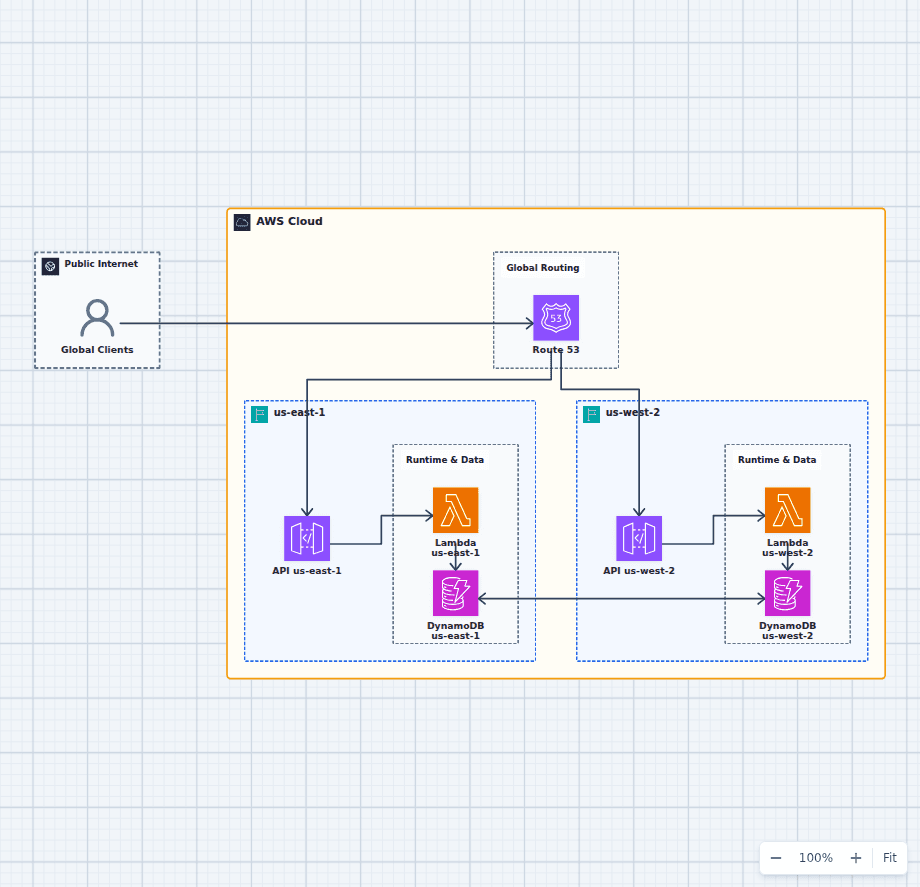
The multi-region serverless API diagram makes the regional replicas visible. Notice that regional API Gateway, Lambda, and data services are distinct resources rather than one vague global component.
Data decides the difficulty
S3 replication, DynamoDB global tables, Aurora Global Database, database replicas, backups, and event replication all offer different consistency and recovery behavior. Decide which Region can accept writes, what happens during a network partition, and how the system reconciles conflicting changes.
Do not hide these decisions behind the word "replication." Measure lag and define the authority model.
Traffic failover needs health and judgment
Route 53, Global Accelerator, and CloudFront can steer traffic, but the health signal must represent the service customers need. Automatic failover based on a shallow check can route users toward an application whose database is unavailable. Manual approval can be safer for rare regional events if the runbook is quick and practiced.
Test the recovery path
Run game days. Restore data, promote replicas, scale capacity, switch traffic, validate authentication, check third-party allowlists, and measure the achieved RTO and RPO. Include the decision to fail back.
Multi-region architecture is justified when regional risk exceeds the additional complexity. Start with clear objectives and choose the simplest pattern that can meet them.