Continuous delivery has become a hallmark of modern software development. The promise is compelling: every change that passes a trusted pipeline can move toward production quickly. Some teams conclude that scheduled releases, approvals, and staged exposure are relics.
Large systems and regulated products make the reality more nuanced. Delivery automation and release management solve different problems.
The case for continuous delivery
Continuous delivery makes the main branch releasable through automated build, test, security, and deployment steps. It shortens the feedback loop, reduces manual variation, and lets small changes move independently.
Small batches are easier to understand than quarterly bundles. When something fails, fewer changes compete as possible causes. Engineers spend less time following manual runbooks and more time improving the system.
Why release management still matters
Deployment puts software into an environment. Release exposes behavior to users or business processes. Those moments can be separate.
Release management is useful when a change has a large blast radius, a regulatory approval, a customer communication plan, a coordinated data migration, or a specific business launch time. It also helps teams define ownership, readiness, and rollback before pressure arrives.
The mistake is turning release management into a calendar full of approvals that do not reduce risk.
Use a hybrid model
Automate the path to production, then apply release controls according to risk. Low-risk backend fixes may roll out continuously. A new checkout flow can deploy dark behind a feature flag, open to employees, expand to a small customer cohort, and then reach everyone.
Canary releases and progressive delivery preserve speed while limiting exposure. Controlled deployments start with a small part of the fleet and expand only when real production signals remain healthy.
Monitoring and rollback are product features
A deployment pipeline is incomplete without feedback. Watch error rate, latency, saturation, customer outcomes, and the health of downstream dependencies. Mark releases on dashboards.
Automated rollback is valuable when the threshold is trustworthy and the change is reversible. Database and event-schema changes often need forward compatibility rather than a simple binary rollback.
Build the guardrails into the architecture
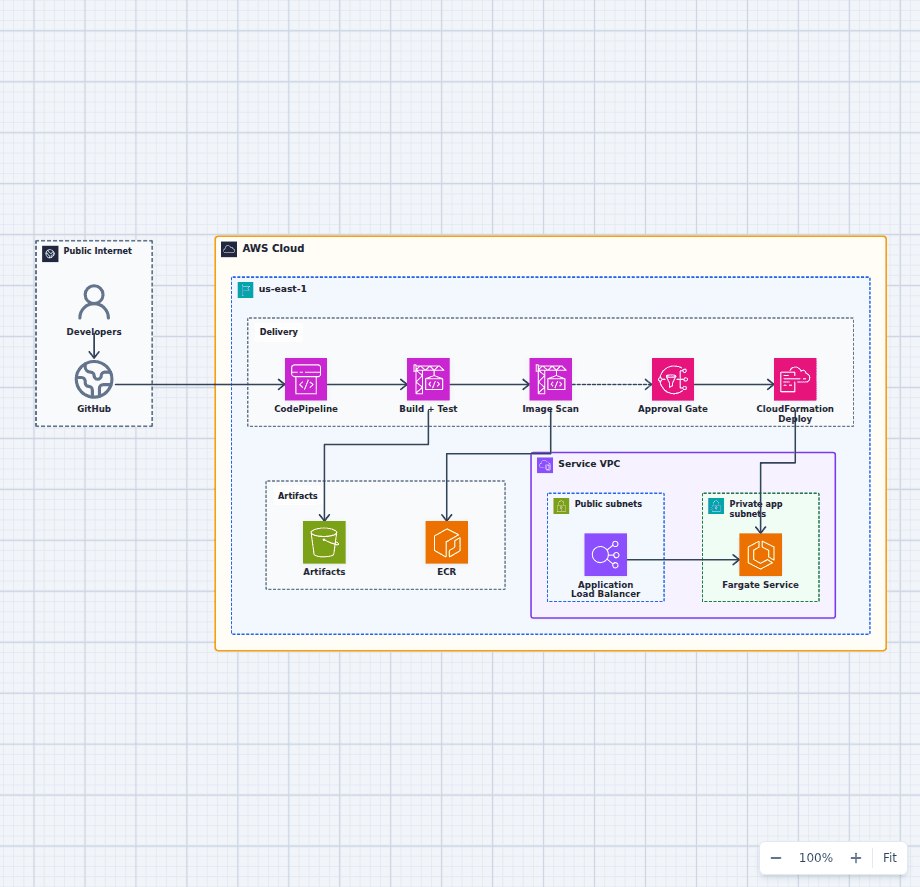
The CI/CD pipeline to ECS Fargate shows source, build, image storage, deployment, runtime, and monitoring as one path. The production high-availability web platform shows the environment that receives those releases.
Ask four questions for each change:
- Can it deploy independently?
- Can it remain hidden after deployment?
- What signal proves it is safe to expand?
- What action limits impact if it is wrong?
The future is not continuous delivery instead of release management. It is continuous delivery with release guardrails that are proportional to real risk.