
Real-Time Streaming Analytics on AWS
A streaming path from Kinesis through Lambda and Data Firehose into an S3 analytics lake queried by Athena and visualized in QuickSight.
Open editable diagramArchitecture diagram
Edit this exact diagram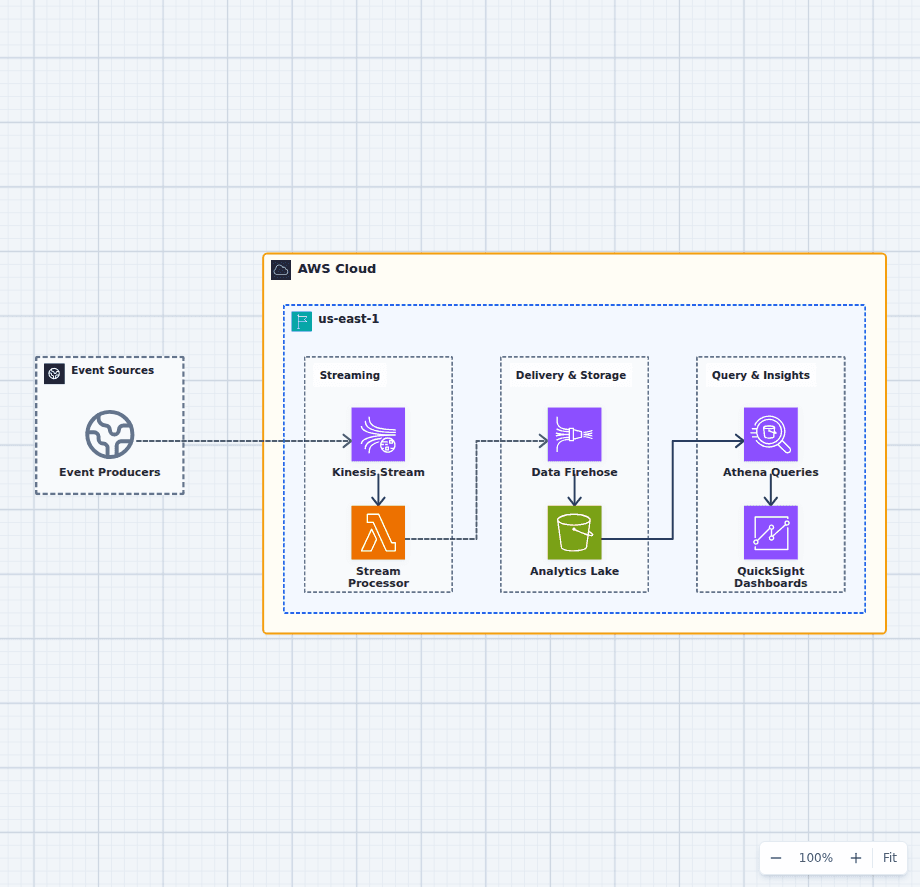 Open on the canvas
AWS streaming analytics diagram with Kinesis, Lambda, Data Firehose, S3, Athena, and QuickSight. The image links to a fully editable BuildPlane starter.
Overview
Event producers publish ordered records to Amazon Kinesis. Lambda validates and enriches those records before Data Firehose batches them into a partitioned S3 analytics lake. Athena provides serverless SQL access, and QuickSight turns query results into dashboards and scheduled reports.
Components
- Kinesis and Lambda: Kinesis buffers ordered events while Lambda validates and enriches records.
- Data Firehose and S3: Firehose batches data into a partitioned analytics lake with durable retention.
- Athena and QuickSight: Athena exposes serverless SQL results that QuickSight turns into dashboards.
Streaming Data Flow
- Producers publish events to Kinesis using workload-appropriate partition keys.
- Lambda transforms records and forwards clean events to Data Firehose.
- Firehose stores batches in S3, where Athena and QuickSight serve analytical views.
Customize First
- Set shard capacity and backpressure alarms from measured event volume.
- Add a dead-letter destination for records that cannot be transformed.
- Define partition projection and data-retention policies before dashboard adoption grows.
Related AWS guides
Understand the decisions behind this diagram
Use these practical explanations to compare services, failure boundaries, and operating tradeoffs before adapting the architecture.
DevOps
AWS Observability: CloudWatch, X-Ray, and CloudTrail Explained
Metrics tell you that customers are hurting. Traces show where a request spent time. Logs explain local detail. CloudTrail records control-plane activity.
Read the guideDevOps
Operational Strategies for Safe Deployments of Real-Time Systems
Real-time systems need frequent change without turning every release into a global gamble. The answer is smaller exposure, useful signals, and fast recovery.
Read the guideArchitecture
Latency vs Throughput: How to Optimize Application Performance
Latency measures how long one request takes. Throughput measures how much work the system completes. They trade against each other, and tuning one without watching the other is how a fast system becomes a slow one under load.
Read the guideDesign rationale
Decisions that shape this architecture
Absorb bursts before processing
Kinesis gives producers a durable buffer and lets processing capacity recover from temporary spikes without dropping accepted records.
Batch writes into the analytics lake
Data Firehose combines small streaming records into more query-efficient S3 objects and can organize delivery by time or dynamic partition keys.
Keep historical data independently queryable
S3 remains the long-term record, so dashboard changes do not require the ingestion stream to replay every event through a permanent database.
Before production
Operational checks
Alarm on iterator age, throttling, transformation errors, and failed Firehose delivery.
Validate partition keys against hot-shard and ordering requirements.
Track schema versions and quarantine records that cannot be parsed safely.
Review S3 object size, partition count, Athena scan volume, and dashboard freshness.
Scope and tradeoffs
What this diagram does not solve
Athena is not a sub-second streaming database
Use a purpose-built operational analytics store when applications need continuously updated low-latency queries rather than lake-oriented analysis.
Exactly-once business effects require application design
Retries can deliver a record more than once. Consumers and downstream aggregations should use stable event IDs and idempotent writes.
Common questions
Frequently asked questions
Why place Lambda before Data Firehose?
Lambda can validate and enrich records before Firehose batches them for storage, keeping malformed or incomplete events out of trusted analytical partitions.
How quickly can dashboards update?
Freshness depends on stream processing, Firehose buffering, S3 partition discovery, Athena queries, and QuickSight refresh settings. Define the required delay before tuning each stage.
Can this architecture support replay?
Kinesis retains a bounded stream history, while S3 provides durable long-term records. Reprocessing jobs should read the appropriate source based on the replay window.
Keep exploring
Related AWS architectures
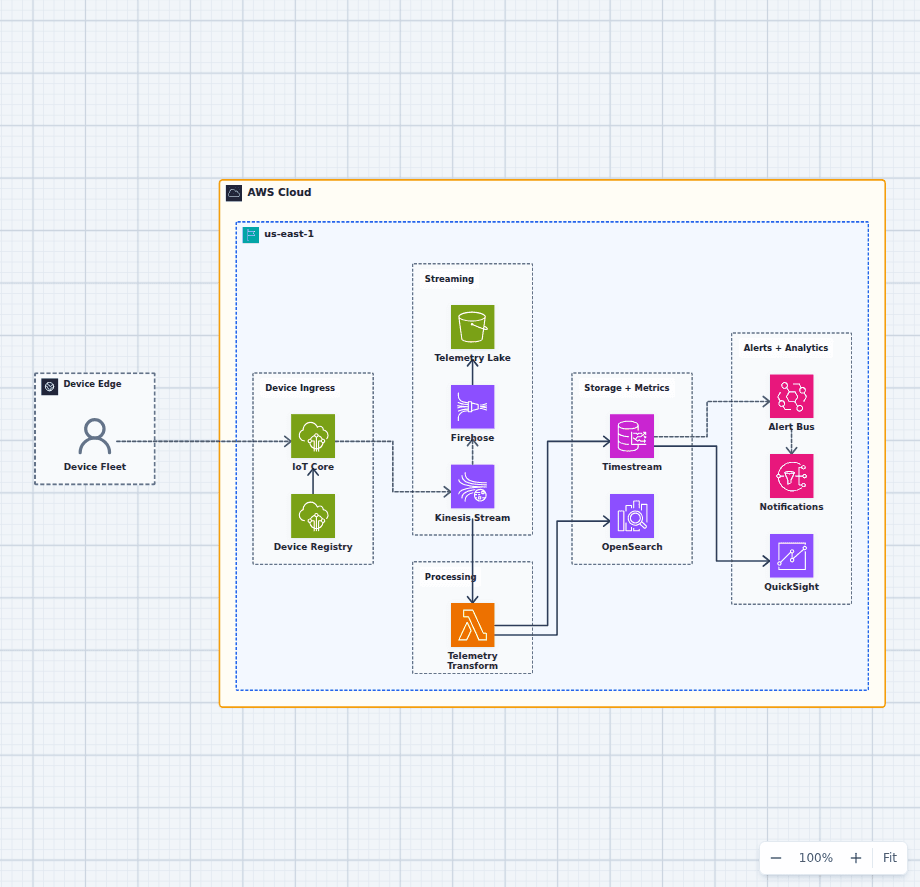
IoT Telemetry and Analytics Platform on AWS
This architecture authenticates a device fleet, buffers telemetry, preserves raw events, derives searchable and time-series views, raises operational alerts, and presents fleet trends. Each storage path serves a distinct access pattern instead of treating one database as universal.
Explore the architecture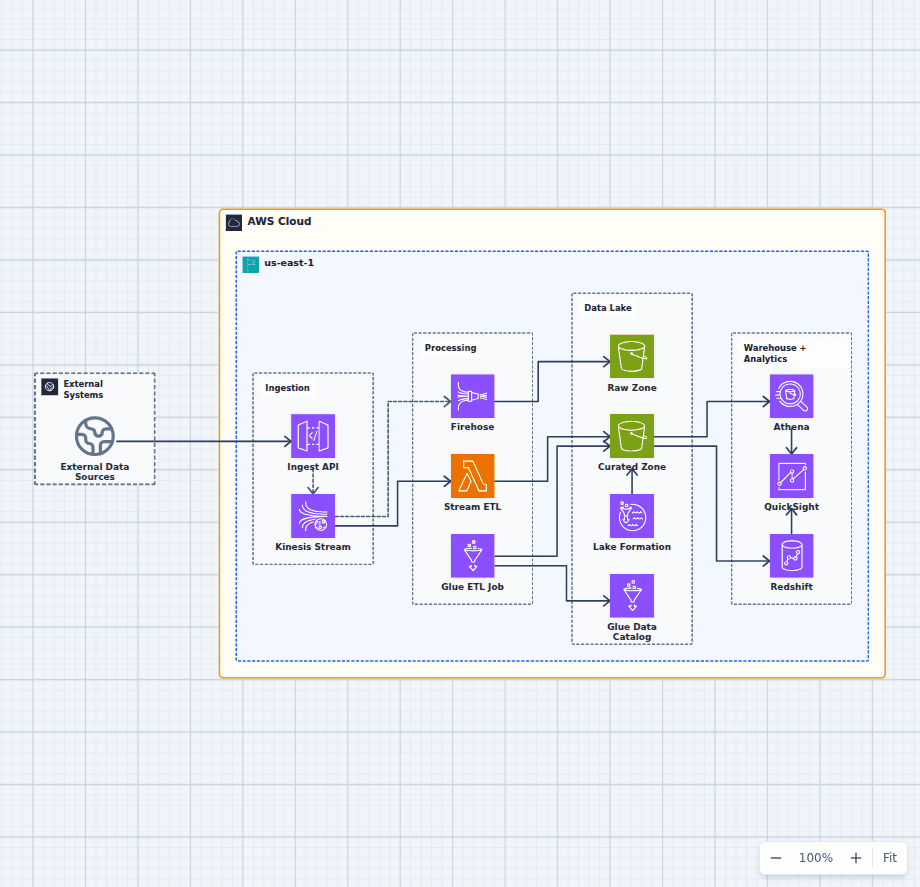
Governed Data Lake and Analytics Platform on AWS
This architecture supports both near-real-time processing and batch-oriented curation. Kinesis fans data into a fast Lambda path and a Firehose landing path, Glue creates query-ready datasets, and Lake Formation applies governance across Athena, Redshift, and QuickSight.
Explore the architecture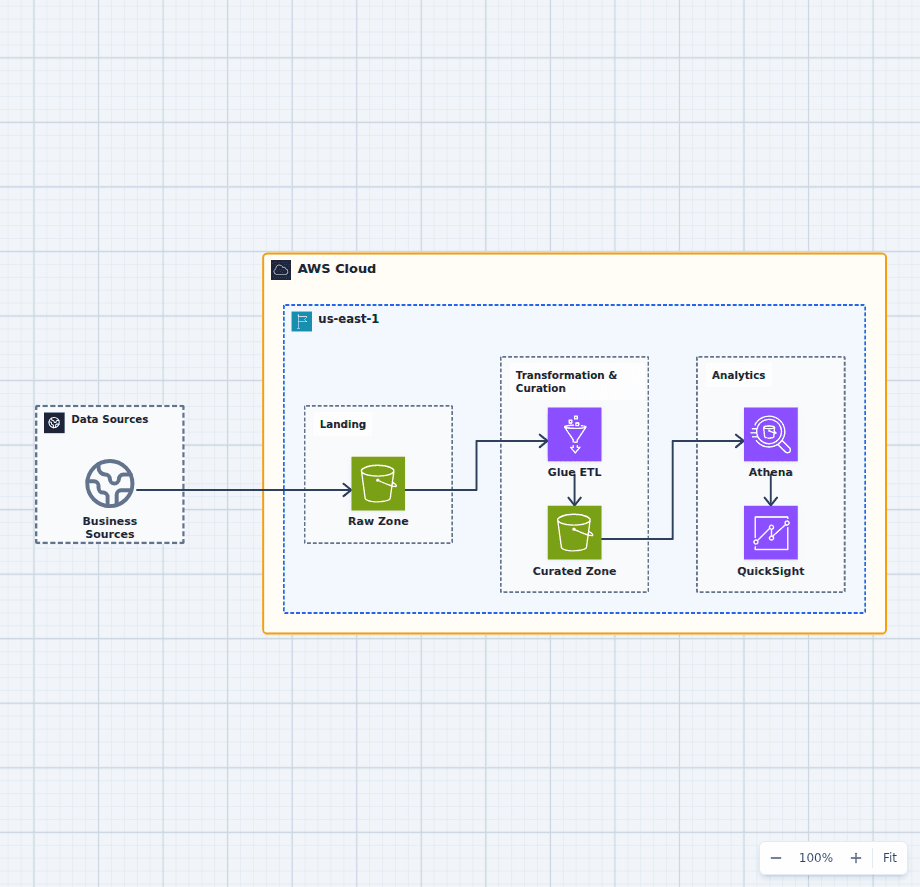
AWS Data Lakehouse Analytics Architecture
This lakehouse architecture makes the progression from source-aligned data to curated analytical products explicit. Durable S3 zones preserve replayability, managed transformation creates trusted datasets, and serverless query and dashboard services keep the first platform operationally light.
Explore the architectureFrom reference to working draft
Adapt this architecture with your AWS AI Agent
Start from the exact diagram in this guide. Change requirements, challenge a decision, or ask what fails first, while keeping the architecture editable.