
IoT Telemetry and Analytics Platform on AWS
Device fleet authenticated by an IoT registry into IoT Core, streamed through Kinesis and Firehose, transformed and anomaly-scored by Lambda into an S3 lake, Timestream, and OpenSearch, with EventBridge/SNS alerts and QuickSight.
Open editable diagramArchitecture diagram
Edit this exact diagram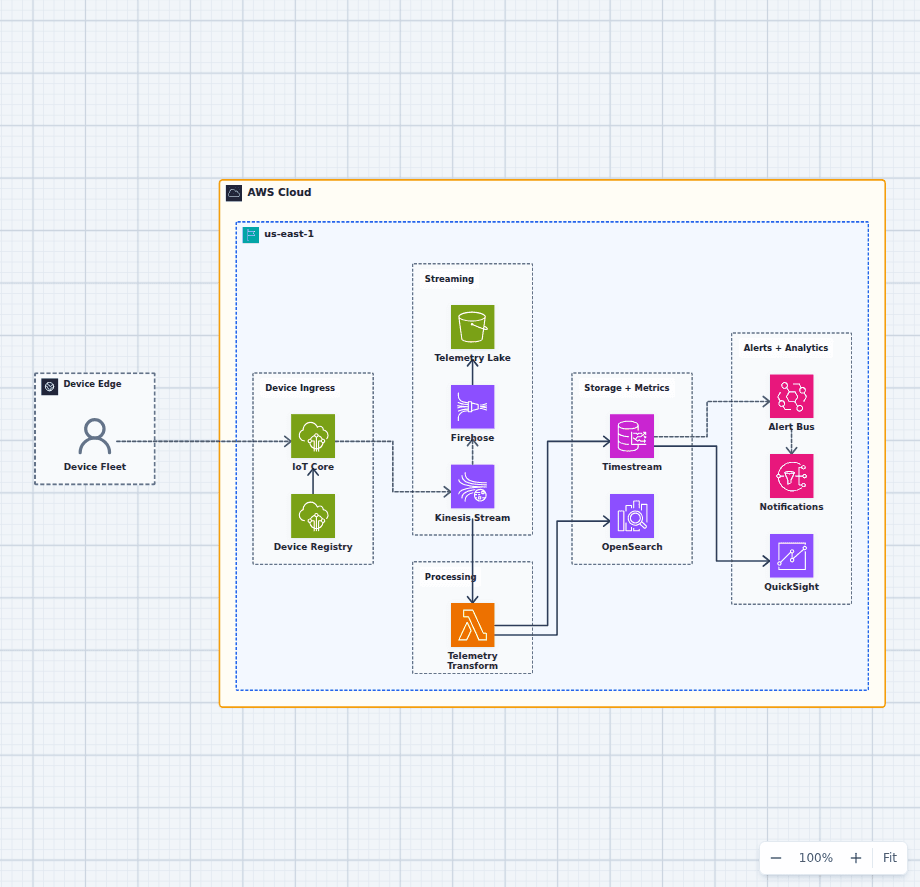 Open on the canvas
AWS IoT telemetry analytics architecture diagram with IoT Core, device registry, Kinesis, Firehose, Lambda, S3, Timestream, OpenSearch, EventBridge, SNS, and QuickSight. The image links to a fully editable BuildPlane starter.
Overview
Registered devices authenticate with AWS IoT Core, which sends telemetry into Amazon Kinesis. Firehose archives raw events in Amazon S3, while Lambda transforms readings for Amazon Timestream and OpenSearch. EventBridge and Amazon SNS deliver threshold alerts, and Amazon QuickSight visualizes fleet trends.
Components
- Device Ingress: IoT Core brokers MQTT while the registry authenticates devices by certificate.
- Streaming: Kinesis buffers real-time telemetry; Firehose batches it into the raw lake.
- Processing: A transform Lambda derives metrics from the stream.
- Storage + Metrics: Timestream holds time-series metrics and OpenSearch indexes telemetry for search.
- Alerts + Analytics: Metric breaches flow through EventBridge to SNS; QuickSight renders fleet dashboards.
Telemetry Flow
- Devices authenticate via the registry and publish telemetry to IoT Core.
- IoT Core streams messages into Kinesis, which feeds Firehose and the transform Lambda.
- Firehose archives raw telemetry to S3 while the transform writes metrics to Timestream and OpenSearch.
- Timestream threshold breaches publish to EventBridge, which alerts operators through SNS.
- QuickSight reads Timestream to visualize fleet health and trends.
Customize First
- Add device shadows, OTA updates, or Greengrass for edge processing.
- Replace the anomaly Lambda with a SageMaker endpoint or Lookout for Equipment.
- Tune Timestream retention tiers and OpenSearch index lifecycle for cost.
Related AWS guides
Understand the decisions behind this diagram
Use these practical explanations to compare services, failure boundaries, and operating tradeoffs before adapting the architecture.
DevOps
Operational Strategies for Safe Deployments of Real-Time Systems
Real-time systems need frequent change without turning every release into a global gamble. The answer is smaller exposure, useful signals, and fast recovery.
Read the guideArchitecture
Latency vs Throughput: How to Optimize Application Performance
Latency measures how long one request takes. Throughput measures how much work the system completes. They trade against each other, and tuning one without watching the other is how a fast system becomes a slow one under load.
Read the guideDesign rationale
Decisions that shape this architecture
Authenticate devices independently
The IoT registry and certificates give each device an identity and policy boundary. Shared credentials make revocation and blast-radius control much harder.
Preserve raw telemetry before enrichment
Firehose archives source messages to S3 while Lambda builds derived views. Raw retention supports replay, model changes, and incident analysis.
Use purpose-built stores
Timestream serves time-windowed metrics, OpenSearch serves exploratory search, and S3 provides durable history. Retention and duplication should be justified by consumer needs.
Before production
Operational checks
Automate certificate provisioning, rotation, revocation, and fleet audit.
Define behavior for late, duplicated, out-of-order, and malformed readings.
Tune Kinesis shards and downstream concurrency from measured ingest volume.
Apply retention and lifecycle policies to Timestream, OpenSearch, and S3.
Scope and tradeoffs
What this diagram does not solve
Connectivity is not guaranteed
Devices need local buffering, reconnect behavior, sequence handling, and an offline operating model. Cloud architecture alone cannot make an unreliable network reliable.
Three data stores increase governance work
Teams must define which store is authoritative for each use case, how derived data is rebuilt, and how deletion and privacy requirements propagate.
Common questions
Frequently asked questions
Why use Kinesis after IoT Core?
Kinesis provides a scalable stream that can feed multiple ordered processing and delivery paths with independent consumers.
Why store telemetry in both Timestream and S3?
Timestream supports operational time-series queries. S3 provides lower-cost durable history for replay, large analytics, and future transformations.
Where should IoT alerts be evaluated?
Simple rules can run near ingest, while richer anomaly detection may run in Lambda or an ML service. The design should match latency, state, and model needs.
Keep exploring
Related AWS architectures
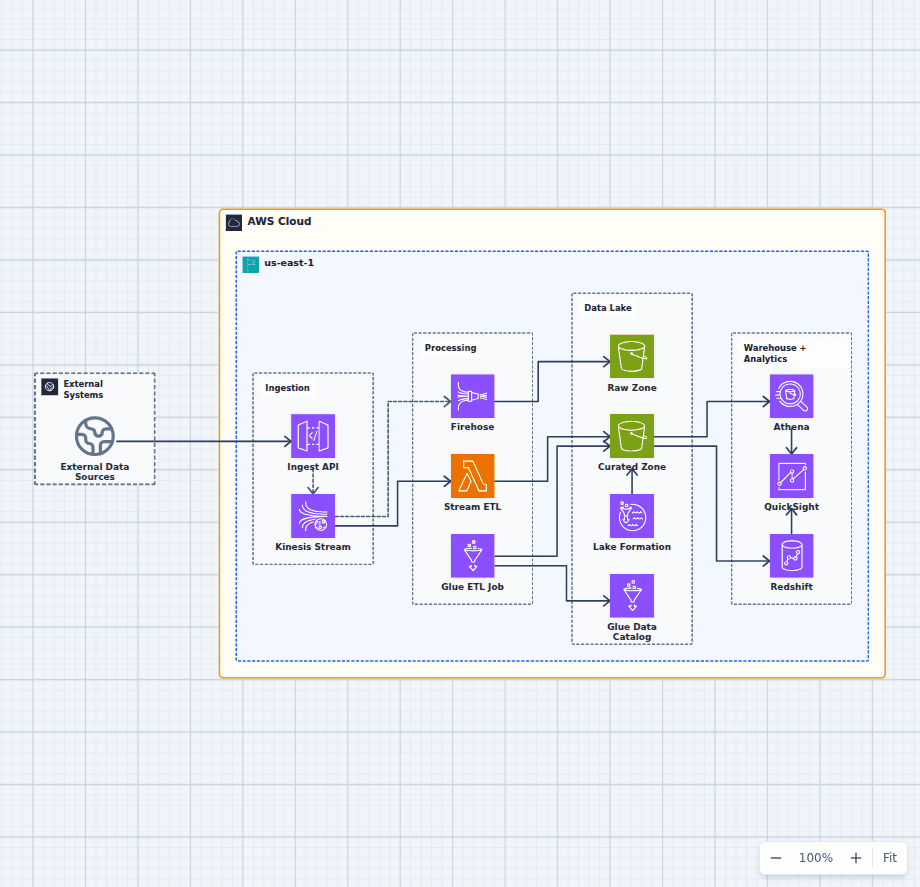
Governed Data Lake and Analytics Platform on AWS
This architecture supports both near-real-time processing and batch-oriented curation. Kinesis fans data into a fast Lambda path and a Firehose landing path, Glue creates query-ready datasets, and Lake Formation applies governance across Athena, Redshift, and QuickSight.
Explore the architecture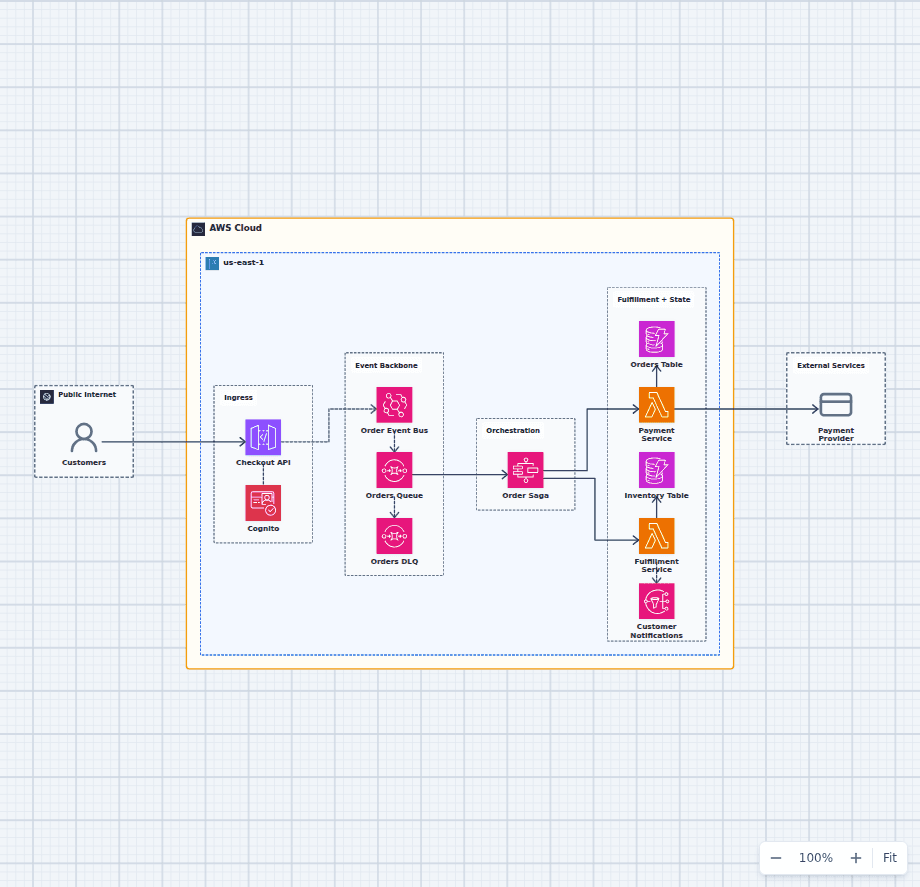
Event-Driven Order Processing Architecture on AWS
This design accepts an order through an authenticated API, publishes a durable domain event, and uses a saga to coordinate payment, inventory, fulfillment, and notification. It separates request latency from business processing while preserving explicit recovery paths.
Explore the architecture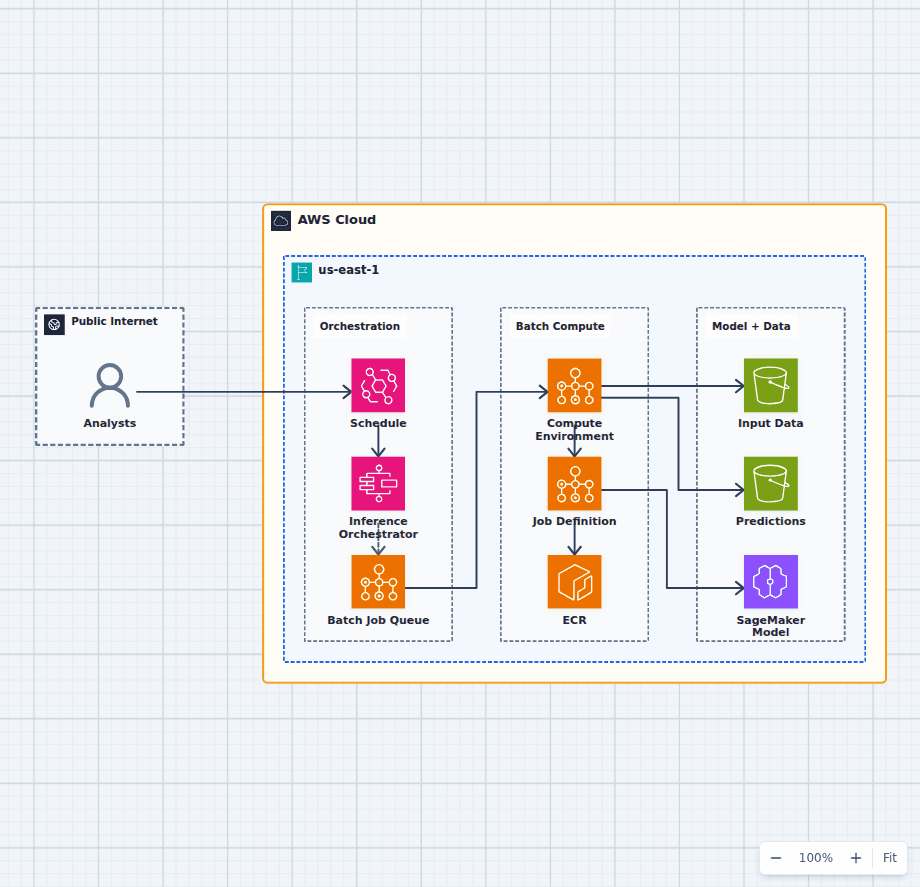
Machine Learning Batch Inference Platform on AWS
This architecture runs scheduled or on-demand scoring as a durable workflow. Step Functions coordinates jobs, AWS Batch supplies container compute, ECR pins the runtime, an approved SageMaker model supplies the artifact, and S3 preserves inputs and predictions.
Explore the architectureFrom reference to working draft
Adapt this architecture with your AWS AI Agent
Start from the exact diagram in this guide. Change requirements, challenge a decision, or ask what fails first, while keeping the architecture editable.