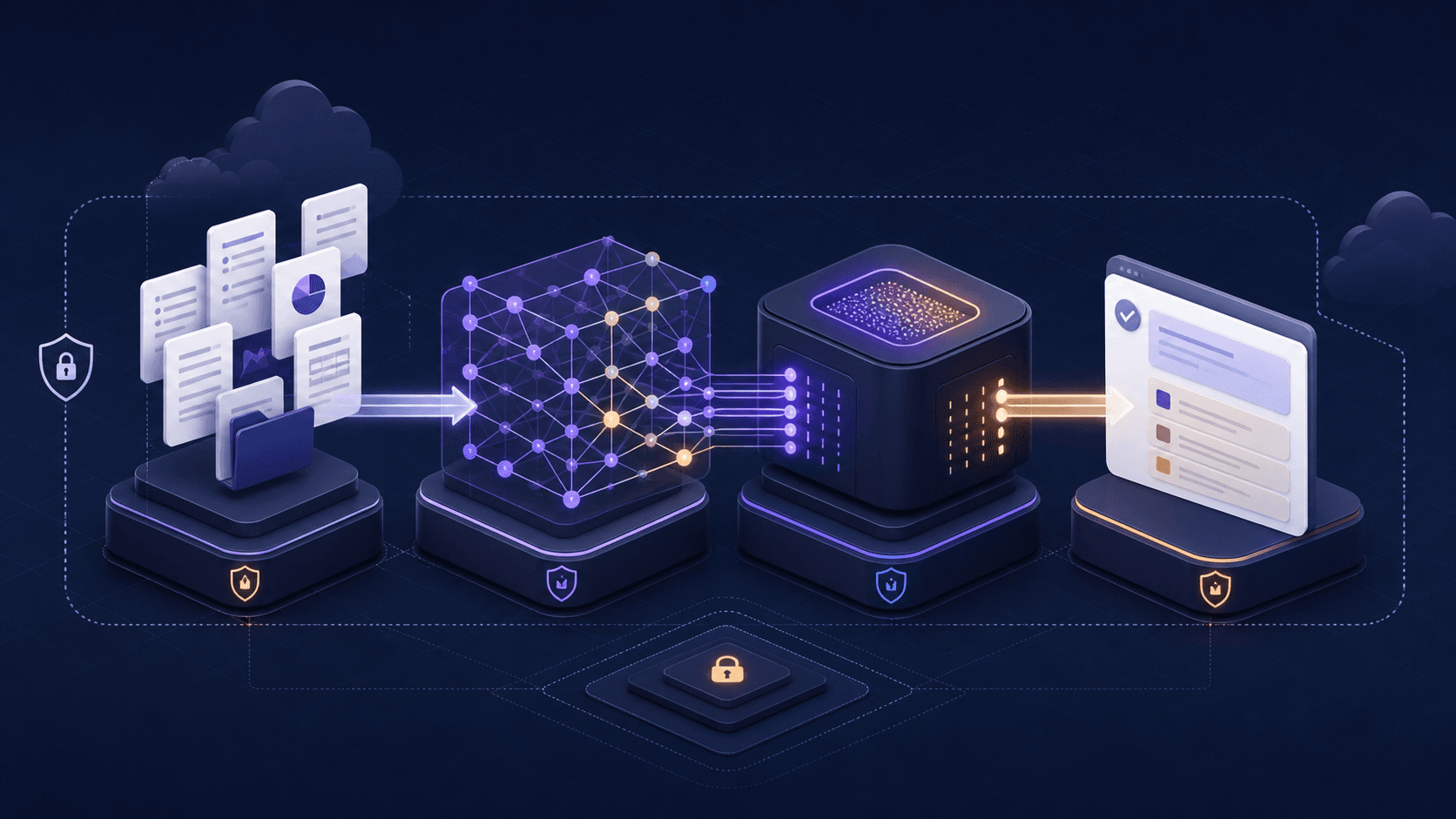
Retrieval-augmented generation, or RAG, gives a model selected context from a controlled knowledge source before it produces an answer. It can improve relevance and citations, but only when the ingestion, retrieval, security, and evaluation layers are treated as production systems.
Ingest and govern the source material
Documents often land in S3. An ingestion workflow extracts text, normalizes formats, removes unsupported content, splits documents into chunks, attaches metadata, and records version and source ownership.
Chunk size is not a universal setting. Small chunks can lose context. Large chunks can dilute retrieval and consume the model context window. Evaluate chunking with real questions from the intended users.
Create embeddings and a vector index
An embedding model converts each chunk into a vector. The system stores vectors with the original text, document identifier, access metadata, and useful filters. OpenSearch Service, Aurora PostgreSQL with vector capabilities, and Bedrock Knowledge Bases are possible implementation paths with different operational tradeoffs.
Re-embedding is a data migration. Track the embedding model and version so old and new vectors do not mix silently.
Build the synchronous answer path
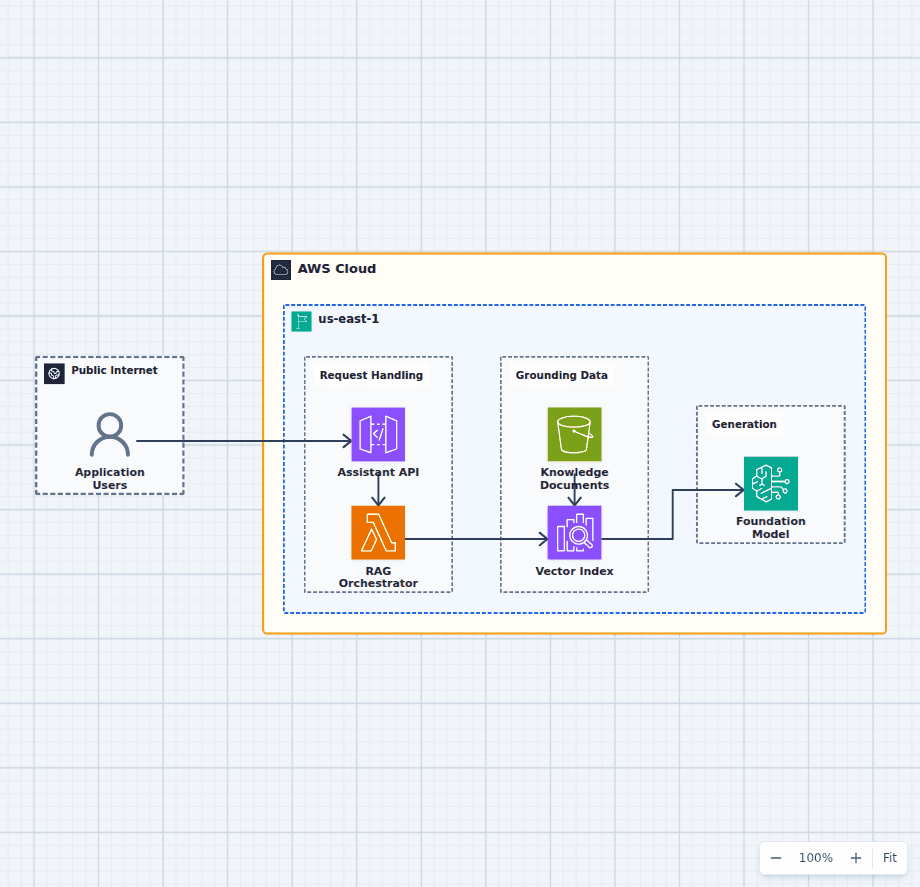
A user authenticates to the application and submits a question. API Gateway and Lambda can provide a compact managed request path. The orchestrator creates a query embedding, retrieves relevant chunks, optionally reranks them, builds a grounded prompt, and invokes a foundation model through Amazon Bedrock.
The generative AI RAG assistant diagram shows this flow without hiding the knowledge layer behind one AI box.
Carry authorization into retrieval
Document access is not solved by authenticating the API. The retrieval query must filter out chunks the current identity cannot access. Otherwise, a model can reveal private material through a perfectly valid prompt.
Keep tenant, department, sensitivity, and document permissions in retrieval metadata. Test negative cases where a user asks directly for content they should not see.
Make citations verifiable
Return source identifiers and links with the answer. Citations should map to text actually retrieved and support the claim they accompany. Do not let the model invent references. A useful UI lets the reader open the source context.
Evaluate the complete system
Build a question set with expected sources and acceptable answer criteria. Measure retrieval recall, context relevance, groundedness, citation accuracy, latency, token use, refusal behavior, and safety. Review changes to chunking, embeddings, prompts, indexes, and models against the same set.
Operate for failure and cost
Set model timeouts, concurrency limits, retry rules, and fallback behavior. Cache only where identity and freshness allow it. Track cost per successful answer, not only tokens per call. Log prompts and responses only under an explicit privacy and retention policy.
Keep this controlled retrieval path separate from public web visibility. Website X-Ray's AWS RAG vs public AI Discoverability comparison explains the different access, indexing, freshness, citation, and measurement models.
RAG is valuable because it connects a model to current, owned knowledge. The architecture is successful when users can trust what was retrieved, why they were allowed to see it, and where the answer came from.