
Serverless Multi-Tenant SaaS Architecture on AWS
Edge-cached API with WAF, Cognito tenant identity, a per-tenant Lambda service, EventBridge-driven async jobs on an SQS queue, an idempotent worker, DynamoDB with Streams, and S3 assets.
Open editable diagramArchitecture diagram
Edit this exact diagram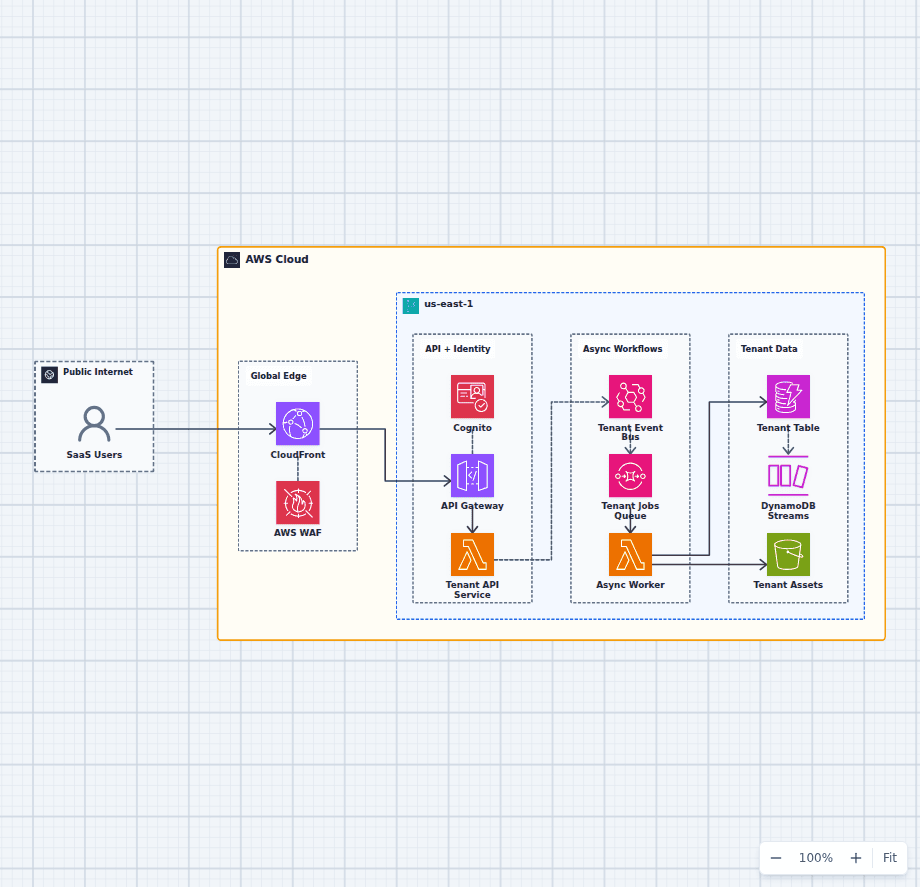 Open on the canvas
Serverless multi-tenant SaaS AWS architecture diagram with CloudFront, WAF, Cognito, API Gateway, Lambda, EventBridge, SQS, DynamoDB Streams, and S3. The image links to a fully editable BuildPlane starter.
Overview
Amazon CloudFront and AWS WAF protect the public API before requests reach API Gateway and Amazon Cognito. Tenant-aware Lambda functions process synchronous requests, while EventBridge and Amazon SQS route domain events to background workers. DynamoDB, DynamoDB Streams, and Amazon S3 provide durable application state, change events, and object storage.
Components
- Edge + API: CloudFront and WAF front an API Gateway REST surface with tenant-scoped usage plans.
- Identity: Cognito issues JWTs carrying the tenant claim used for authorization and data partitioning.
- Async Workflows: EventBridge decouples writes from work; an SQS queue (with dead-letter redrive) feeds an idempotent worker Lambda.
- Tenant Data: A single DynamoDB table with Streams drives change-data workflows; S3 holds per-tenant assets.
- Operations: The worker owns durable writes so retries stay idempotent and the read model is rebuildable from the stream.
Request Flow
- A user hits CloudFront, which forwards API traffic through WAF to API Gateway.
- API Gateway authorizes with Cognito and invokes the tenant API Lambda.
- The tenant Lambda publishes a domain event to EventBridge.
- EventBridge enqueues work; the worker persists tenant state to DynamoDB and writes assets to S3.
- DynamoDB Streams captures the change for downstream projections.
Customize First
- Choose your tenant isolation model (pool, bridge, or silo) and adjust data partitioning accordingly.
- Wire the DynamoDB stream to an OpenSearch projection or a metering pipeline as your read path grows.
- Add a billing webhook handler (e.g. Stripe) and SES for transactional email as separate integrations.
Related AWS guides
Understand the decisions behind this diagram
Use these practical explanations to compare services, failure boundaries, and operating tradeoffs before adapting the architecture.
AWS Fundamentals
Top 10 AWS Services Every Cloud Builder Should Know
AWS has hundreds of services, but a small group appears in most real systems. Learn these ten as architectural building blocks, not isolated definitions.
Read the guideAWS Certification
AWS Cloud Practitioner Services Cheat Sheet for CLF-C02
This is a service map, not an alphabetical glossary. Use the comparisons to recognize what an exam scenario is actually asking for.
Read the guideArchitecture
First Byte Latency vs Last Byte Latency: What Each Metric Tells You
TTFB tells you how quickly a response begins. TTLB tells you when the response finishes. A fast start can still hide a slow transfer or an unusable page.
Read the guideDesign rationale
Decisions that shape this architecture
Carry tenant identity through every boundary
Cognito claims identify the tenant, but API authorization, event payloads, database keys, object prefixes, logs, and metrics must preserve that context consistently.
Separate request acceptance from durable work
The API publishes a domain event instead of performing every downstream action synchronously. EventBridge routes the event and SQS provides retryable worker delivery.
Choose an explicit tenant-isolation model
A pooled DynamoDB table can scale efficiently, but partition keys and IAM conditions must prevent cross-tenant access. Higher-isolation customers may justify bridge or silo variants.
Before production
Operational checks
Test cross-tenant authorization at the API, worker, table, and object-storage layers.
Make asynchronous writes idempotent and define dead-letter redrive ownership.
Meter usage by tenant without placing billing work in the request path.
Track noisy-neighbor signals such as per-tenant throttling and queue depth.
Scope and tradeoffs
What this diagram does not solve
Serverless does not remove tenancy design
Isolation, quotas, migrations, noisy neighbors, support access, and tenant deletion still require deliberate product and data policies.
The diagram is a backend baseline
Billing, transactional email, search projections, analytics, deployment pipelines, and administrative support flows should be added as distinct integrations when required.
Common questions
Frequently asked questions
How should tenant data be partitioned in DynamoDB?
A common pooled model includes the tenant identifier in partition keys and every access pattern. The exact key design must follow the product queries and isolation requirements.
Why use both EventBridge and SQS?
EventBridge routes domain events to interested destinations. SQS gives a worker durable buffering, backpressure, retry control, and dead-letter handling.
Can this architecture support enterprise tenants?
It can be extended for enterprise requirements, but stronger isolation, audit, networking, key management, and support-access controls may require bridge or silo deployments.
Keep exploring
Related AWS architectures
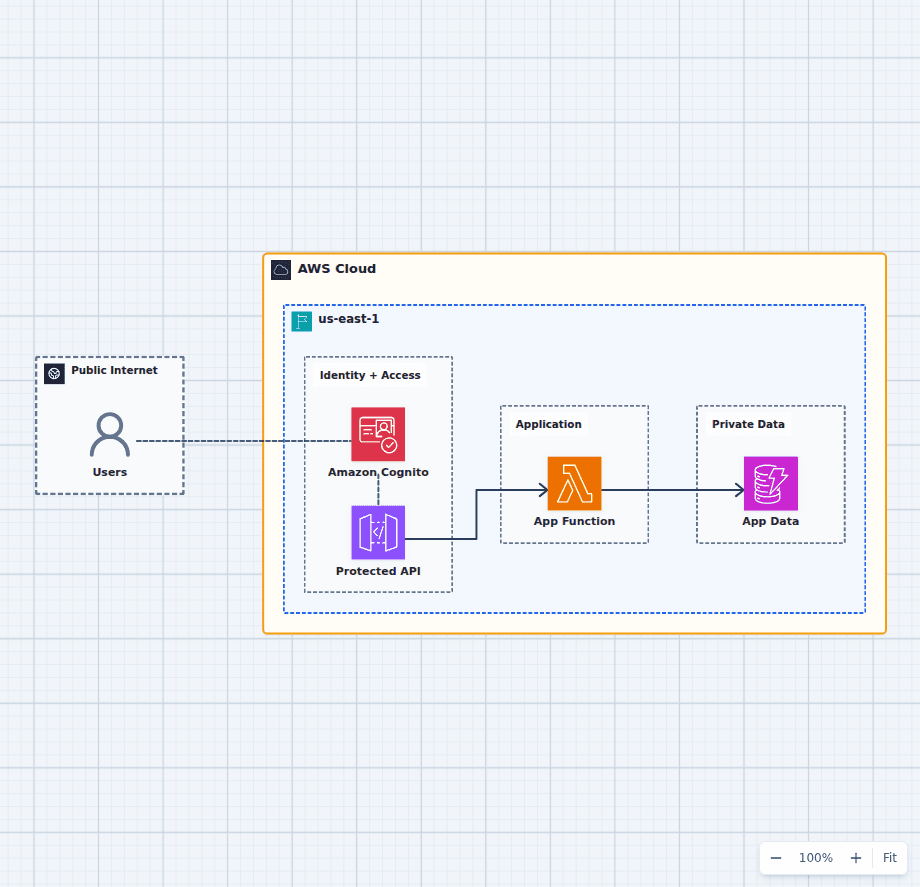
Secure Application Authentication with Amazon Cognito
This architecture separates identity verification from application authorization. Cognito authenticates the user, API Gateway validates the presented token, Lambda enforces business rules, and DynamoDB remains behind the application boundary.
Explore the architecture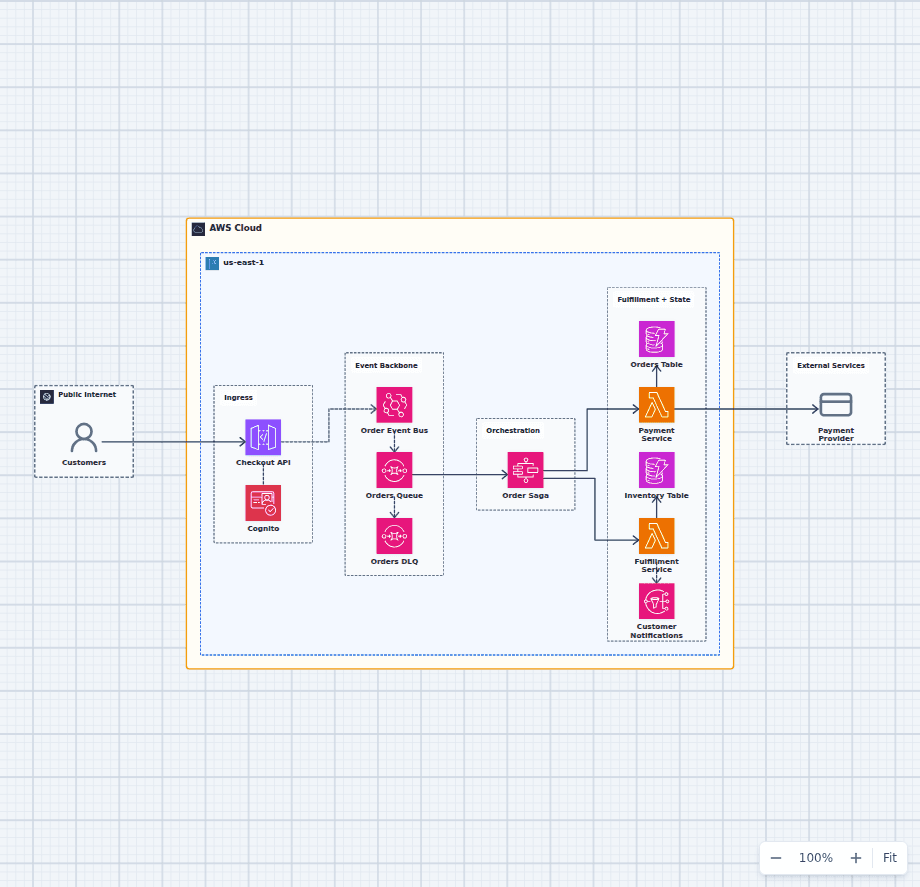
Event-Driven Order Processing Architecture on AWS
This design accepts an order through an authenticated API, publishes a durable domain event, and uses a saga to coordinate payment, inventory, fulfillment, and notification. It separates request latency from business processing while preserving explicit recovery paths.
Explore the architecture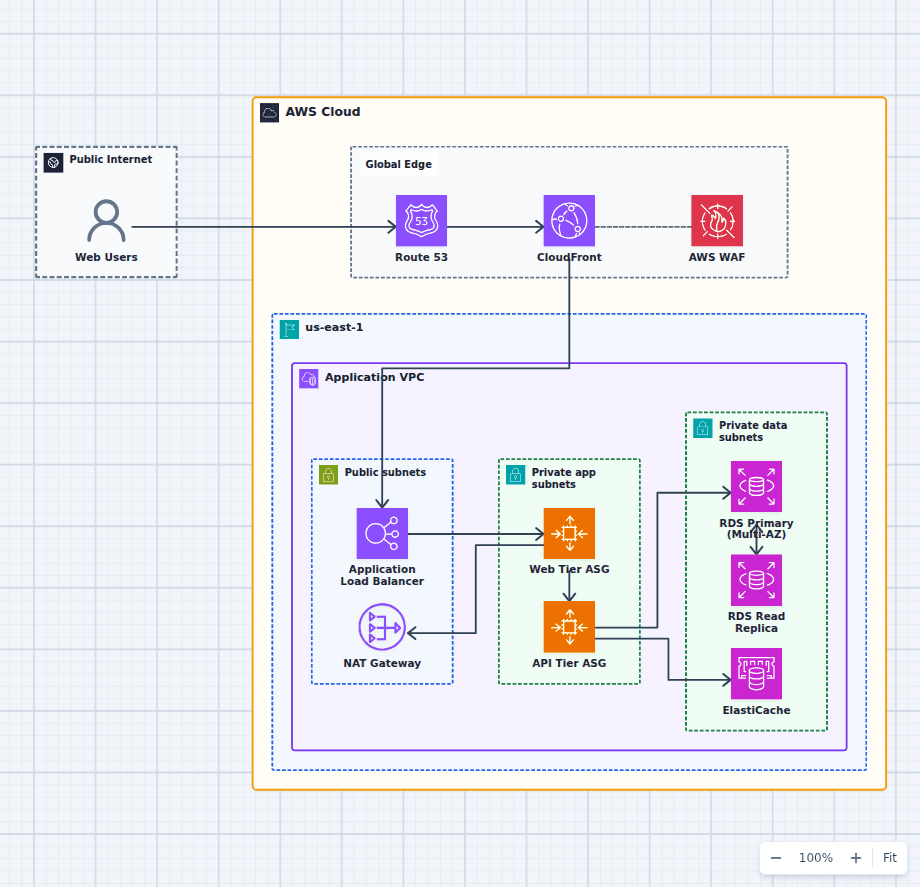
Production-Grade Highly Available Web Platform on AWS
This reference expands the three-tier baseline with a global edge, separate scaling domains, caching, read scaling, private egress, secrets, backups, and operations. It is intended for teams evaluating a conventional production web platform rather than a minimal learning diagram.
Explore the architectureFrom reference to working draft
Adapt this architecture with your AWS AI Agent
Start from the exact diagram in this guide. Change requirements, challenge a decision, or ask what fails first, while keeping the architecture editable.