
ECS on Fargate vs Amazon EKS
Compare AWS-native ECS orchestration on Fargate with managed Kubernetes on EKS for container platforms, teams, and operations.
Open editable diagramArchitecture diagram
Edit this exact diagram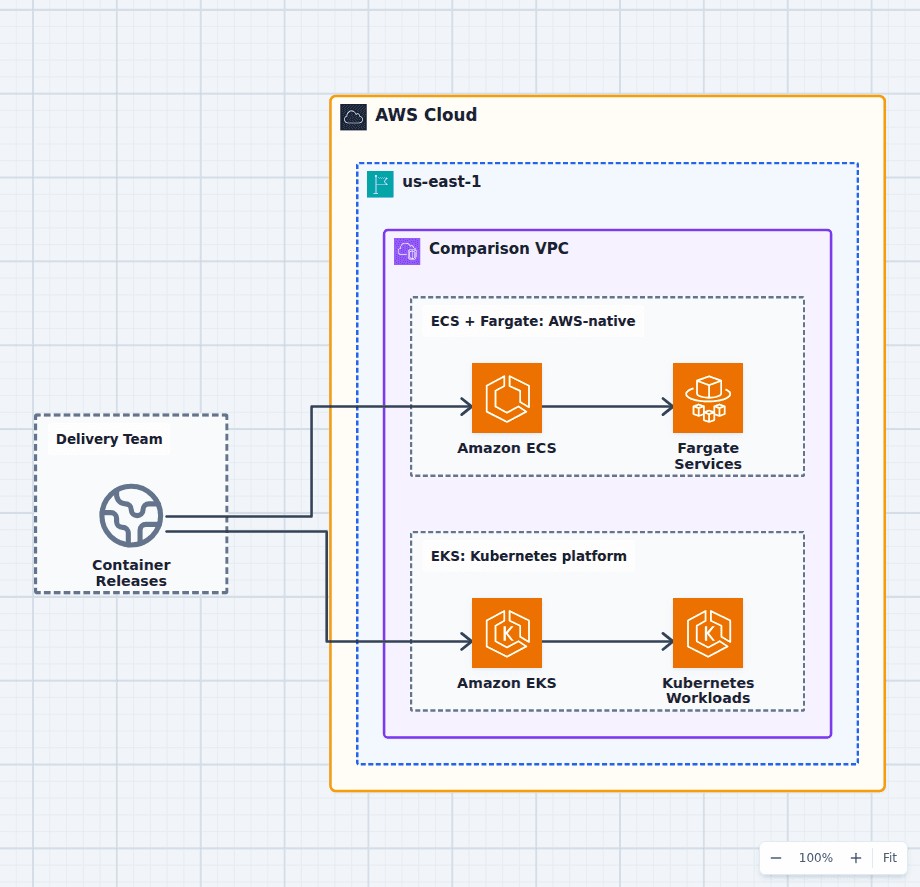 Open on the canvas
ECS Fargate vs EKS architecture diagram comparing AWS-native Amazon ECS services on Fargate with Kubernetes workloads on Amazon EKS. The image links to a fully editable BuildPlane starter.
Overview
Amazon ECS and Amazon EKS are container orchestrators, while AWS Fargate is serverless compute capacity that either orchestrator can use. The common comparison called Fargate vs EKS usually means an AWS-native ECS service running on Fargate versus a Kubernetes platform running on EKS. ECS reduces platform surface area; EKS provides Kubernetes APIs, ecosystem compatibility, and portability while asking a team to own more platform decisions.
Components
- Shared decision context: Versioned container images and deployment configuration from the delivery pipeline.
- Amazon ECS: AWS-native task and service orchestration with a smaller platform surface. Serverless container tasks with no worker node fleet to patch or bin-pack.
- Amazon EKS: Managed Kubernetes control plane for teams that need Kubernetes APIs and tooling. Deployments, Services, operators, policies, and add-ons owned as a platform.
Comparison Flow
- Container Releases can enter the Amazon ECS path and continue to Fargate Services.
- Container Releases can instead enter the Amazon EKS path and continue to Kubernetes Workloads.
- Choose the path whose operating model and constraints match the workload, then delete the unused branch in the editable diagram.
Customize First
- Choose EKS worker capacity separately: managed node groups, Karpenter, or Fargate profiles.
- Add the ingress controller, service mesh, and policy stack only if they are real requirements.
- Compare team experience and platform ownership before comparing feature checklists.
Side-by-side decision
ECS on Fargate vs Amazon EKS
Default to ECS on Fargate when containers are the requirement and Kubernetes is not. Choose EKS when Kubernetes APIs, tooling, skills, policy, or portability are requirements strong enough to justify the larger platform surface.
| Decision factor | ECS on Fargate | Amazon EKS |
|---|---|---|
| Orchestrator | AWS-native ECS tasks and services | Managed Kubernetes control plane |
| Compute | Fargate tasks | Managed nodes, Karpenter, self-managed nodes, or Fargate |
| Platform surface | Task definitions, services, capacity providers | Pods, Deployments, Services, ingress, add-ons, policies, CRDs |
| Portability | AWS-specific APIs | Kubernetes API and ecosystem |
| Operations | Lower control-plane and add-on burden | Cluster upgrades and platform add-ons remain team responsibilities |
| Best fit | Small teams and AWS-first services | Kubernetes-skilled organizations and shared platforms |
Related AWS guides
Understand the decisions behind this diagram
Use these practical explanations to compare services, failure boundaries, and operating tradeoffs before adapting the architecture.
Design rationale
Decisions that shape this architecture
Compare orchestrator to orchestrator
ECS and EKS decide how containers are declared, scheduled, networked, observed, and deployed. Fargate decides who manages the worker infrastructure. EKS can use Fargate profiles, so treating EKS and Fargate as mutually exclusive hides the most important architecture dimension.
Kubernetes value must exceed Kubernetes ownership
EKS removes control-plane installation but not the platform around it. Teams still choose node provisioning, ingress, DNS, autoscaling, observability, policy, secrets, upgrades, and workload conventions. That investment is worthwhile when the Kubernetes ecosystem and organization-wide platform API create concrete leverage.
ECS makes the AWS path shorter
ECS services, task definitions, IAM roles, CloudWatch, Service Connect, and load balancer integration form a smaller native surface. A team that simply needs to deploy stateless containers can reach production without first assembling a Kubernetes distribution inside the managed service.
Before production
Operational checks
Name the team that owns cluster upgrades, ingress, policy, DNS, observability, and node capacity.
Test deployment rollbacks, disruption handling, autoscaling, and Availability Zone rebalancing.
Compare task or pod startup time and bin-packing under realistic image sizes.
Include EKS control-plane and add-on cost, plus platform engineering labor, in the estimate.
Scope and tradeoffs
What this diagram does not solve
The comparison does not choose EKS capacity
An EKS decision still requires a separate choice among managed node groups, Karpenter-managed EC2 capacity, Fargate profiles, or a mix. GPU, daemon, privileged, and cost-optimization requirements often decide that second layer.
Portability is not automatic
Using Kubernetes does not make an application cloud-neutral if it depends on AWS load balancers, IAM, databases, queues, storage classes, and controllers. Identify which portability scenarios the organization will actually exercise.
Common questions
Frequently asked questions
Is Fargate an alternative to EKS?
Not exactly. Fargate is compute for containers; EKS is a Kubernetes orchestrator. EKS can run pods on Fargate. The more precise common choice is ECS on Fargate versus EKS with an appropriate capacity model.
Is ECS easier than EKS?
For an AWS-first team without a Kubernetes requirement, usually yes. ECS exposes fewer concepts and fewer platform add-ons. A Kubernetes-experienced organization may find EKS familiar, but it still owns more of the platform lifecycle.
When should a small team choose EKS?
When a specific Kubernetes API, operator, policy system, portability commitment, or existing platform practice is important enough to own. Choosing EKS only because Kubernetes is popular usually creates more machinery than the workload needs.
Keep exploring
Related AWS architectures
AWS Lambda vs AWS Fargate
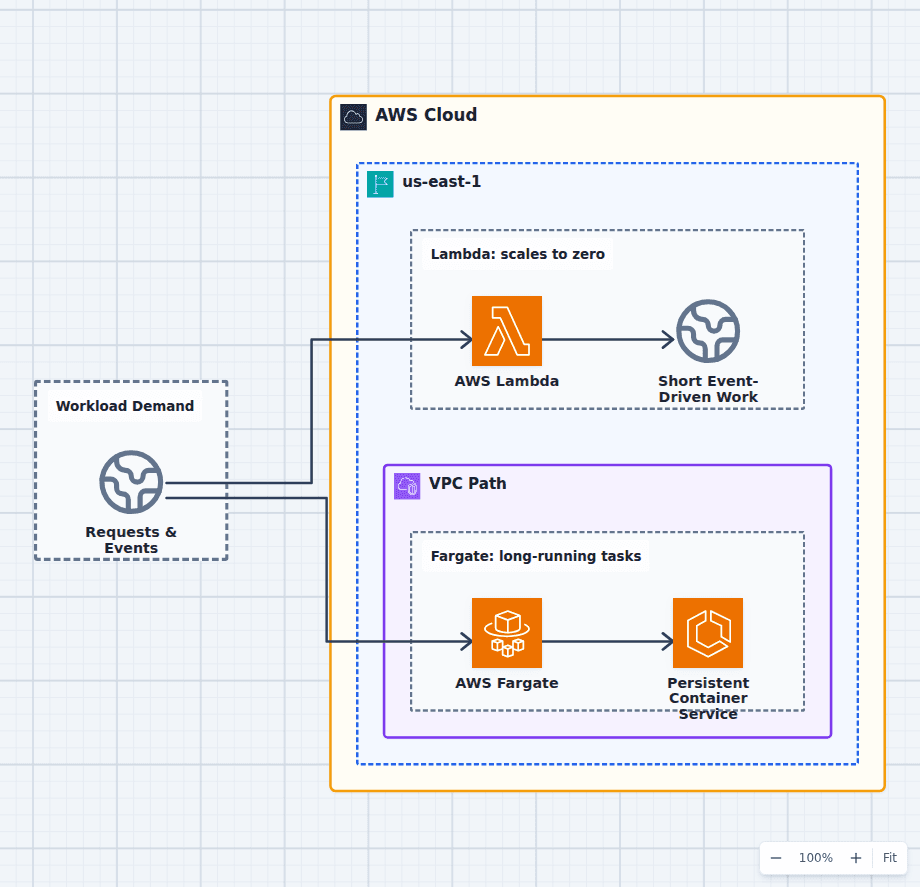
Choose Lambda for short, stateless, event-driven work with variable traffic and a supported runtime model. Choose Fargate for long-running services, background consumers, larger dependencies, custom runtimes, persistent connections, or an existing container image. Real systems often use Fargate for the always-on API and Lambda for bursty side jobs, so the architecture need not force every workload into one compute model.
Explore the architecture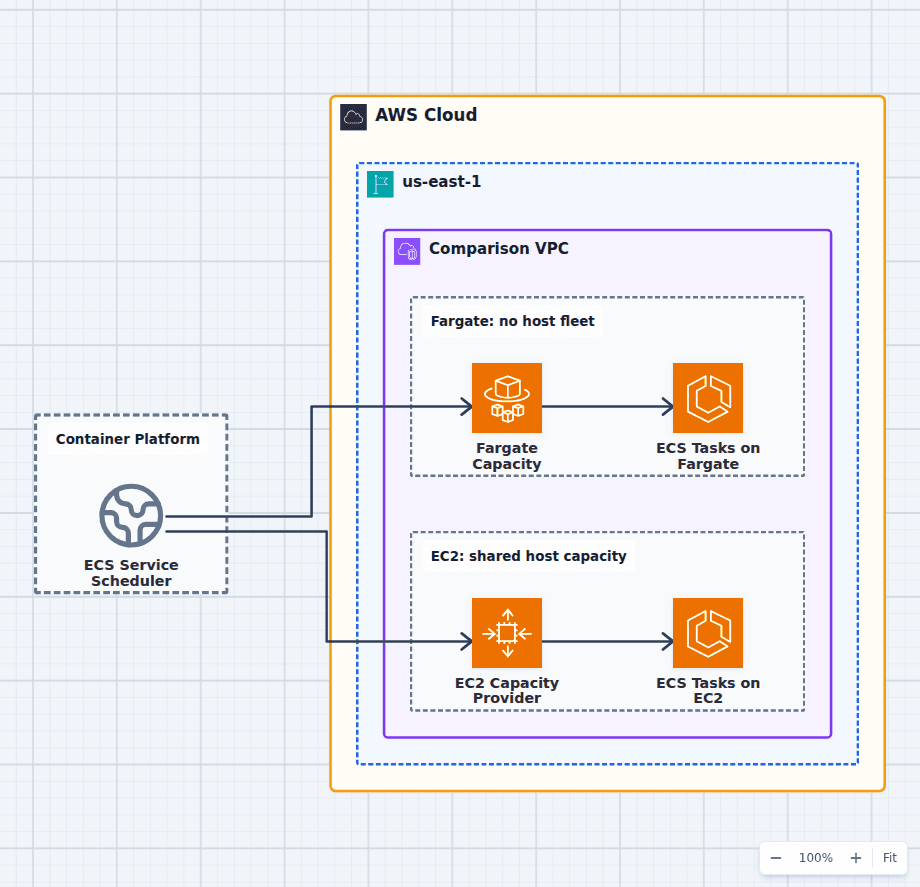
AWS Fargate vs Amazon EC2 for ECS
Choose Fargate when removing host management and isolating capacity per task matter more than the lowest steady-state unit cost. Choose ECS on EC2 when the workload needs GPUs, privileged or daemon access, specialized instances, very high sustained utilization, or deeper control over placement and networking. Capacity providers make this a per-service or mixed-cluster decision rather than an irreversible platform choice.
Explore the architecture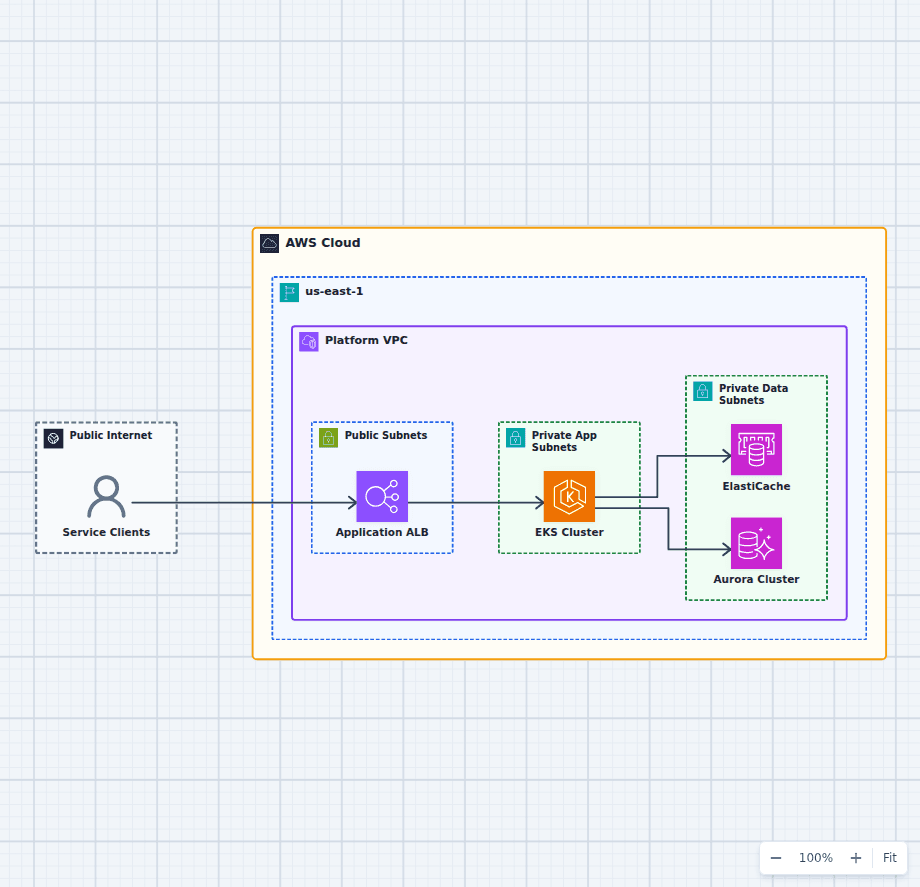
Amazon EKS Microservices Platform
This Kubernetes architecture makes the primary operating boundaries visible without drawing every cluster object. Public ingress, private compute, cache, and relational state are separated so platform teams can reason about scaling, availability, deployment, and data ownership independently.
Explore the architectureFrom reference to working draft
Adapt this architecture with your AWS AI Agent
Start from the exact diagram in this guide. Change requirements, challenge a decision, or ask what fails first, while keeping the architecture editable.