
AWS Fargate vs Amazon EC2 for ECS
Compare serverless Fargate tasks with ECS on EC2 capacity for host control, utilization, GPUs, scaling, patching, and cost.
Open editable diagramArchitecture diagram
Edit this exact diagram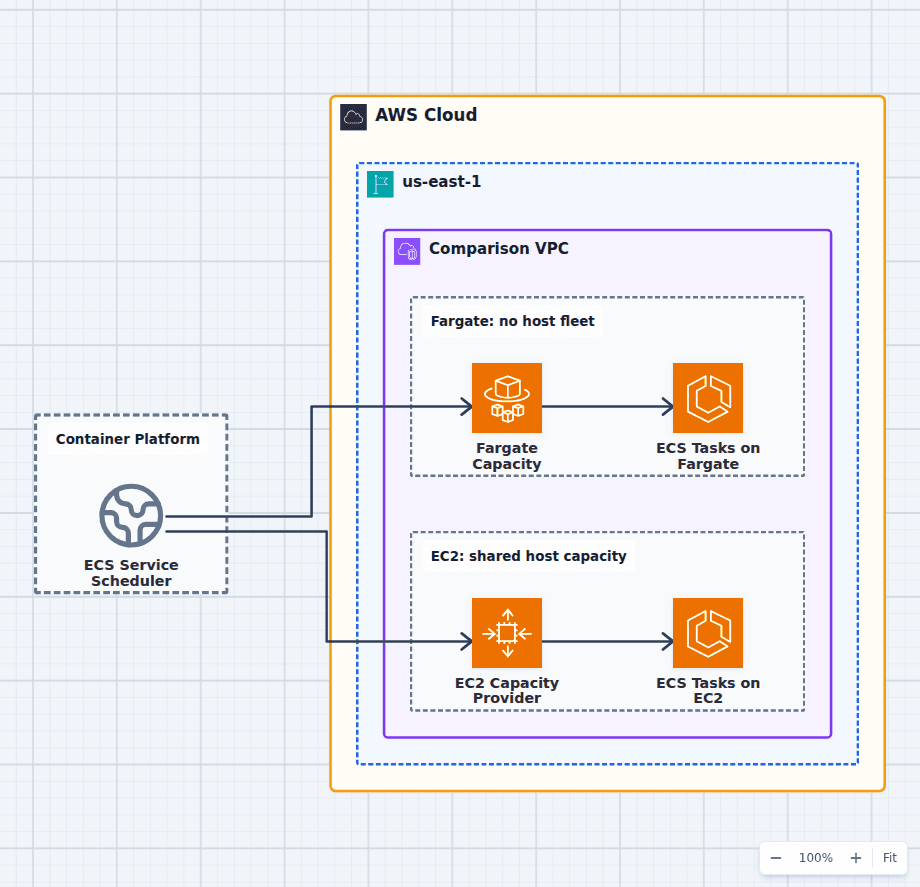 Open on the canvas
AWS Fargate vs EC2 architecture diagram comparing ECS tasks on serverless Fargate capacity with ECS tasks on an EC2 Auto Scaling capacity provider. The image links to a fully editable BuildPlane starter.
Overview
Amazon ECS can run the same task definition on Fargate capacity or on EC2 instances registered with the cluster. Fargate provisions isolated capacity from each task request and removes the instance fleet. EC2 capacity providers let tasks share a fleet that the team sizes and operates, opening more instance types, specialized hardware, placement control, and potential utilization savings.
Components
- Shared decision context: The same ECS service definition requesting container capacity.
- Fargate Capacity: AWS provisions task capacity from requested vCPU, memory, storage, and platform settings. Independently isolated tasks billed from their requested resources.
- EC2 Capacity Provider: An Auto Scaling fleet that the team sizes, patches, secures, and optimizes. Tasks bin-packed onto shared instances with access to specialized instance types.
Comparison Flow
- ECS Service Scheduler can enter the Fargate Capacity path and continue to ECS Tasks on Fargate.
- ECS Service Scheduler can instead enter the EC2 Capacity Provider path and continue to ECS Tasks on EC2.
- Choose the path whose operating model and constraints match the workload, then delete the unused branch in the editable diagram.
Customize First
- Benchmark steady utilization before assuming the lower unit price wins.
- Use Fargate Spot or EC2 Spot only for interruption-tolerant tasks.
- Add GPU or privileged-host requirements to the EC2 path when they are decisive.
Side-by-side decision
AWS Fargate vs ECS on EC2
Use Fargate for operational simplicity and task-level isolation. Use EC2 capacity when host capabilities, specialized instances, or efficient packing of predictable sustained demand justify owning the fleet.
| Decision factor | AWS Fargate | ECS on EC2 |
|---|---|---|
| Infrastructure | AWS-managed task capacity | Customer-managed EC2 fleet |
| Billing unit | Requested task vCPU, memory, and storage | Whole instances, regardless of task occupancy |
| Operations | No host patching or AMI lifecycle | AMI, patching, draining, scaling, and capacity reservations |
| Hardware choice | Supported Fargate sizes and platforms | Broad EC2 families, GPUs, accelerators, local storage |
| Isolation | Task-level infrastructure isolation | Tasks commonly share instances |
| Optimization | Fargate Spot and Savings Plans | Spot, Reserved Instances, Savings Plans, bin-packing |
Related AWS guides
Understand the decisions behind this diagram
Use these practical explanations to compare services, failure boundaries, and operating tradeoffs before adapting the architecture.
Design rationale
Decisions that shape this architecture
Host requirements are a hard boundary
GPU workloads, kernel customization, privileged access, host agents, some storage patterns, and specialized instance families point to EC2. If none of those are requirements, adding a host fleet should have a measurable cost or utilization benefit.
Bin-packing savings come with capacity risk
EC2 can place many tasks onto one instance and improve utilization, but the service now depends on enough compatible instances being available at the right time. Capacity providers, managed scaling, draining, and spare headroom become production controls.
Fargate waste hides in task requests
Fargate bills the CPU and memory requested by every running task, not average use. Over-requesting each task can erase the operational savings, so right-size from Container Insights and load tests rather than copying generous development limits.
Before production
Operational checks
Verify capacity-provider scaling and task placement during deploys and Availability Zone loss.
Right-size CPU, memory, ephemeral storage, and minimum task count.
Test Spot interruption handling before placing critical replicas on discounted capacity.
Include engineering labor, unused EC2 headroom, and Fargate over-requesting in cost models.
Scope and tradeoffs
What this diagram does not solve
One cluster can use both
ECS capacity-provider strategies can spread services or tasks across Fargate, Fargate Spot, and EC2 capacity. Use a mixed design when workload classes have genuinely different interruption or hardware needs.
Launch speed is workload-specific
Image size, registry access, task initialization, instance warm pools, and health checks influence scale-out more than the brand name alone. Measure deployment and burst behavior in the actual network.
Common questions
Frequently asked questions
Is Fargate more expensive than EC2?
Per unit of compute, often yes. Total cost can still be lower when EC2 instances would sit partially idle or require significant platform labor. High, stable, well-packed utilization is where EC2 has the strongest economic case.
Can one ECS cluster run Fargate and EC2 tasks?
Yes. Capacity providers and service strategies can use different capacity types in one cluster, subject to task and placement compatibility.
When is EC2 required for ECS?
Use EC2 when tasks need instance capabilities Fargate does not offer, such as particular GPUs or accelerators, host-level access, specialized networking or storage, or a daemon on every node.
Keep exploring
Related AWS architectures
ECS on Fargate vs Amazon EKS
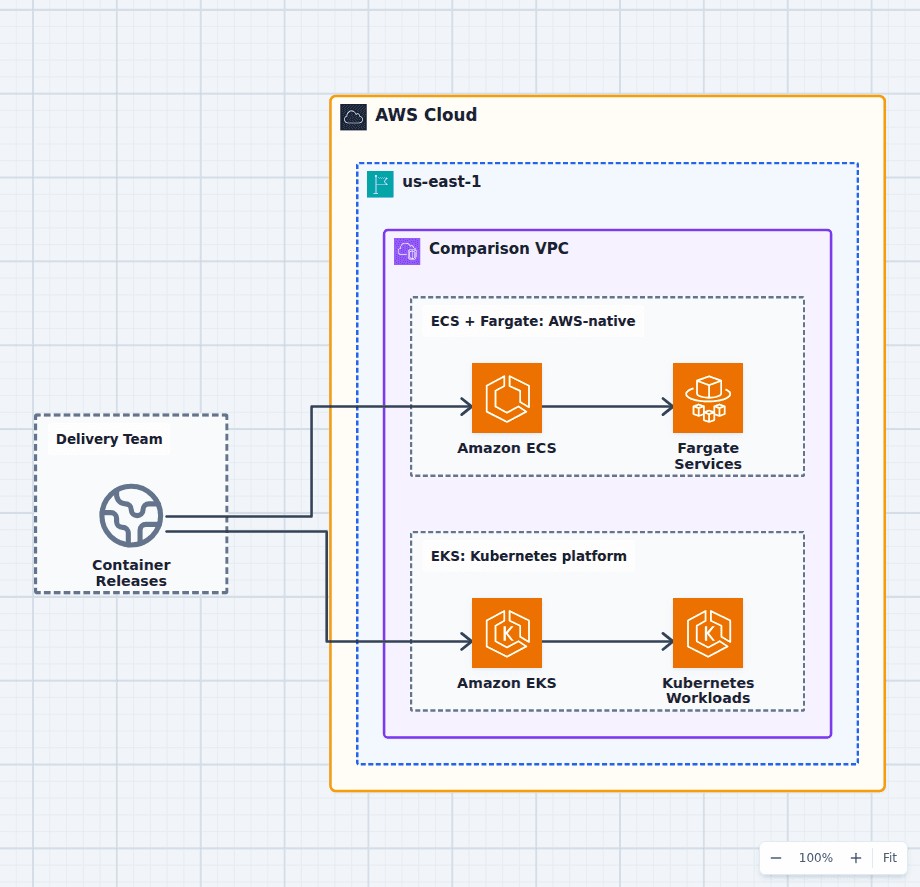
Choose ECS on Fargate when the goal is to run containers with the smallest AWS operations footprint and no Kubernetes requirement. Choose EKS when Kubernetes itself is a strategic interface, the team needs its ecosystem or portability, or many product teams need a common platform abstraction. EKS can still run selected pods on Fargate, which is why separating orchestrator from capacity is essential to a correct decision.
Explore the architecture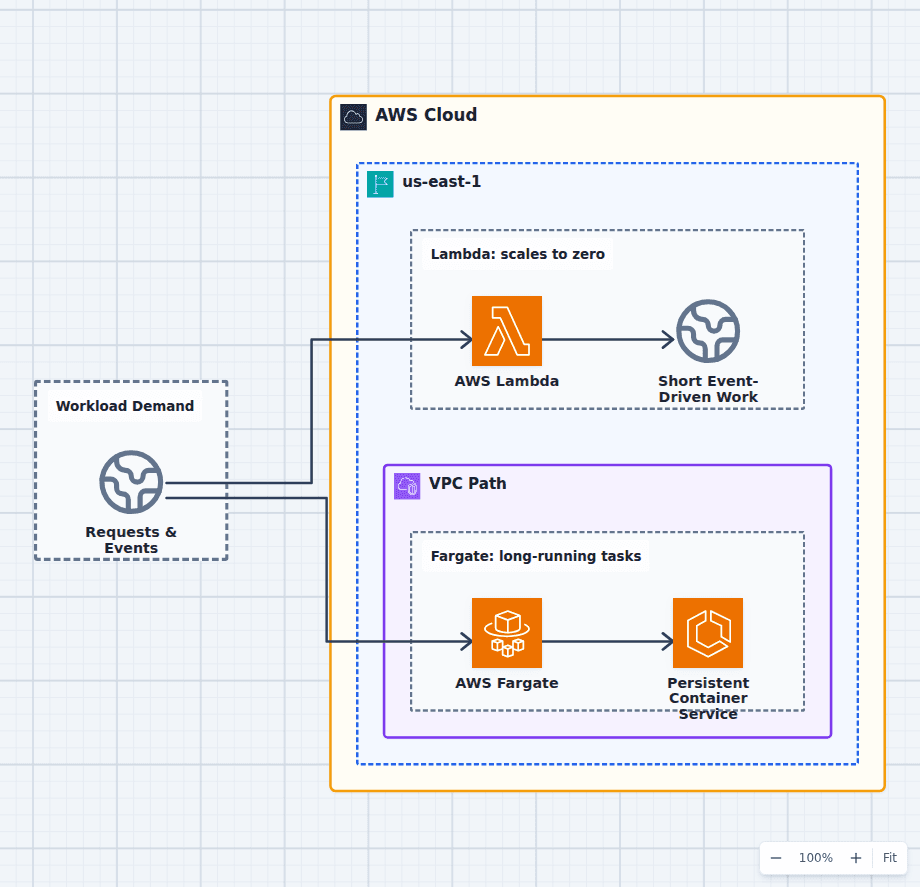
AWS Lambda vs AWS Fargate
Choose Lambda for short, stateless, event-driven work with variable traffic and a supported runtime model. Choose Fargate for long-running services, background consumers, larger dependencies, custom runtimes, persistent connections, or an existing container image. Real systems often use Fargate for the always-on API and Lambda for bursty side jobs, so the architecture need not force every workload into one compute model.
Explore the architecture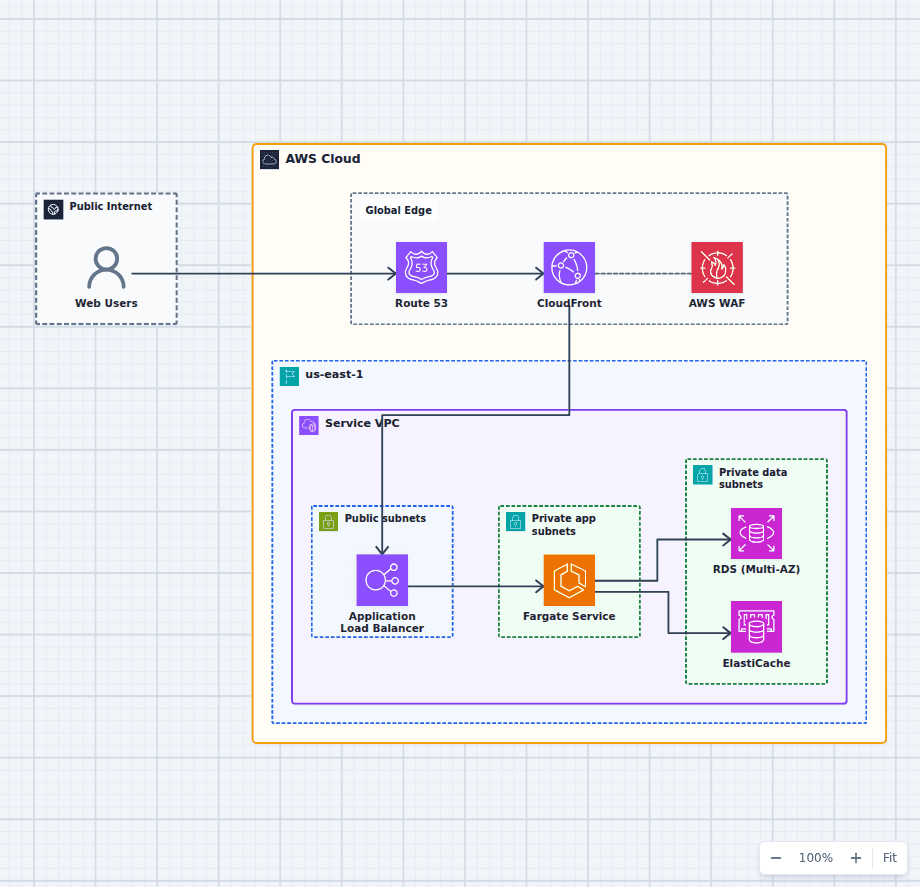
Containerized Web Service with Amazon ECS and Fargate
This architecture runs a production container service without an EC2 host fleet. A protected global edge forwards to a Multi-AZ load balancer, Fargate tasks stay private and reach data services over the VPC network, and managed image, secret, and observability services support the runtime. Every component here is one an ordinary web application needs eventually, which is why this shape is a common destination for teams outgrowing a single server and for teams who found Lambda too constraining.
Explore the architectureFrom reference to working draft
Adapt this architecture with your AWS AI Agent
Start from the exact diagram in this guide. Change requirements, challenge a decision, or ask what fails first, while keeping the architecture editable.