
Amazon CloudFront vs AWS Global Accelerator
Compare a caching HTTP content delivery network with static Anycast IP acceleration for TCP and UDP applications and failover.
Open editable diagramArchitecture diagram
Edit this exact diagram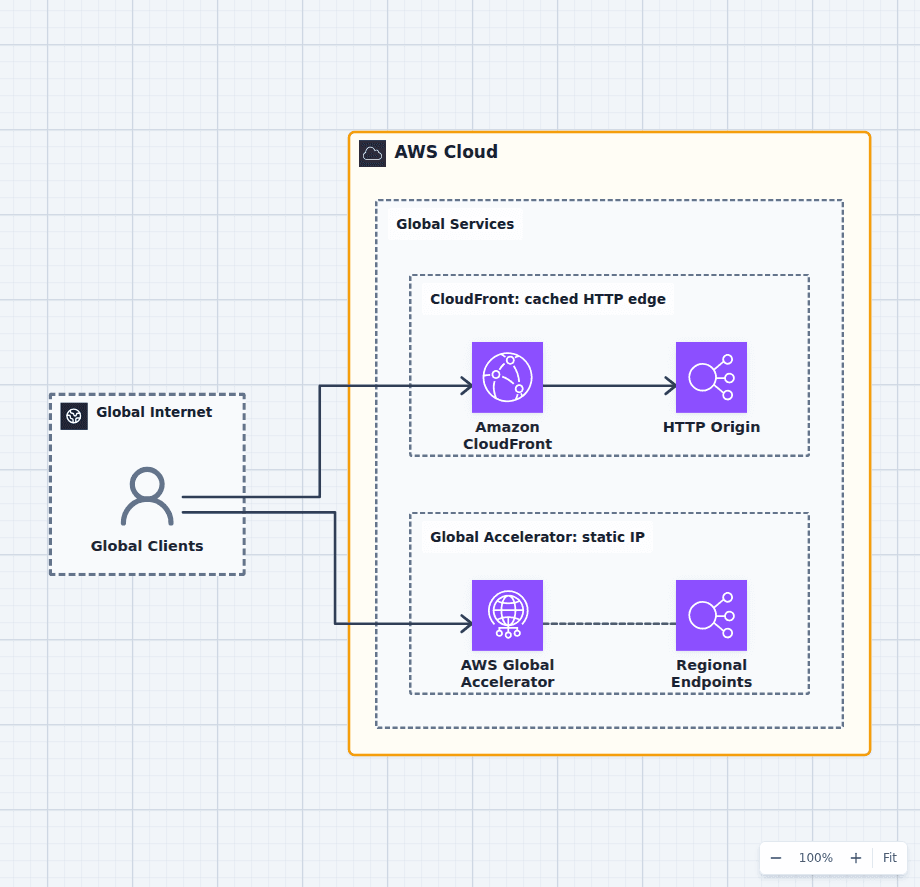 Open on the canvas
CloudFront vs Global Accelerator architecture diagram comparing an HTTP CDN path to an origin with static Anycast TCP and UDP acceleration to regional endpoints. The image links to a fully editable BuildPlane starter.
Overview
Amazon CloudFront is a content delivery network that understands HTTP and can cache responses at edge locations. AWS Global Accelerator is a network accelerator that provides static Anycast IP addresses and carries TCP or UDP connections over the AWS global network to healthy regional endpoints. One optimizes content delivery; the other optimizes network paths and endpoint selection.
Components
- Shared decision context: Users and applications reaching workloads from many networks and geographies.
- Amazon CloudFront: A CDN that understands HTTP, caches responses, runs edge logic, and protects origins. An ALB, S3 bucket, API, or other HTTP origin reached on cache misses.
- AWS Global Accelerator: Routes TCP or UDP connections over the AWS global network using fixed Anycast IP addresses. Healthy ALB, NLB, EC2, or Elastic IP endpoints selected across Regions.
Comparison Flow
- Global Clients can enter the Amazon CloudFront path and continue to HTTP Origin.
- Global Clients can instead enter the AWS Global Accelerator path and continue to Regional Endpoints.
- Choose the path whose operating model and constraints match the workload, then delete the unused branch in the editable diagram.
Customize First
- Classify traffic as cacheable HTTP, dynamic HTTP, TCP, or UDP before choosing.
- Add WAF to CloudFront and Shield Advanced only from the actual threat model.
- Measure client-to-origin latency and failover behavior from real geographies.
Side-by-side decision
Amazon CloudFront vs AWS Global Accelerator
Use CloudFront for HTTP content delivery and caching. Use Global Accelerator for static Anycast IPs, TCP or UDP acceleration, and health-based routing to regional endpoints without a content cache.
| Decision factor | Amazon CloudFront | AWS Global Accelerator |
|---|---|---|
| Layer | Application-layer HTTP CDN | Network-layer TCP and UDP accelerator |
| Caching | Caches eligible content at edge locations | Does not cache application content |
| Client address | DNS distribution hostname and custom domain | Two static Anycast IPv4 addresses; address options vary |
| Backends | HTTP origins such as S3, ALB, APIs, custom servers | ALB, NLB, EC2, and Elastic IP regional endpoints |
| Security features | WAF, signed URLs/cookies, edge functions | DDoS-resilient network entry and endpoint controls |
| Best fit | Web, API, download, media delivery | Dynamic TCP/UDP, games, IoT, static-IP clients |
Related AWS guides
Understand the decisions behind this diagram
Use these practical explanations to compare services, failure boundaries, and operating tradeoffs before adapting the architecture.
Design rationale
Decisions that shape this architecture
Cacheability is the first branch
CloudFront can answer a request from an edge cache and remove latency and load from the origin. Global Accelerator always forwards the connection to a regional endpoint. If objects or responses can be cached safely, that architectural difference is larger than network-path optimization alone.
Static IPs can simplify external dependencies
Global Accelerator provides stable Anycast addresses that clients and firewalls can allow-list while endpoint membership changes behind them. CloudFront is normally consumed through DNS and is designed for HTTP clients that resolve names.
Failover operates on different objects
CloudFront selects origins and can continue serving cached objects during origin trouble. Global Accelerator evaluates endpoint groups and health to shift new connections across endpoints or Regions. Test the exact failure and connection behavior the application needs.
Before production
Operational checks
Classify cacheable and uncacheable traffic by path and method.
Test failover from multiple client regions and networks.
Review origin or endpoint health checks, timeouts, DNS, and connection lifetime.
Model data transfer, request, acceleration, invalidation, and endpoint charges.
Scope and tradeoffs
What this diagram does not solve
Neither removes regional architecture
Origins and endpoints still need load balancing, scaling, data strategy, and independent regional health. An edge service cannot make one stateful regional backend multi-Region.
Using both adds another decision boundary
A system can use CloudFront for web content and Global Accelerator for latency-sensitive non-HTTP traffic. Sending the same path through both is uncommon and should have a measured reason.
Common questions
Frequently asked questions
Does Global Accelerator cache content?
No. It optimizes network routing and endpoint selection. CloudFront is the service that caches HTTP content at edge locations.
Which service provides static IP addresses?
Global Accelerator provides static Anycast addresses. CloudFront provides a distribution domain name and custom-domain support rather than a small fixed address set for allow-listing.
Can CloudFront accelerate APIs?
Yes. It can proxy and accelerate dynamic HTTP requests even when responses are not cached, while also applying WAF and edge logic. Global Accelerator is stronger when transport protocols or static IPs are decisive.
Keep exploring
Related AWS architectures
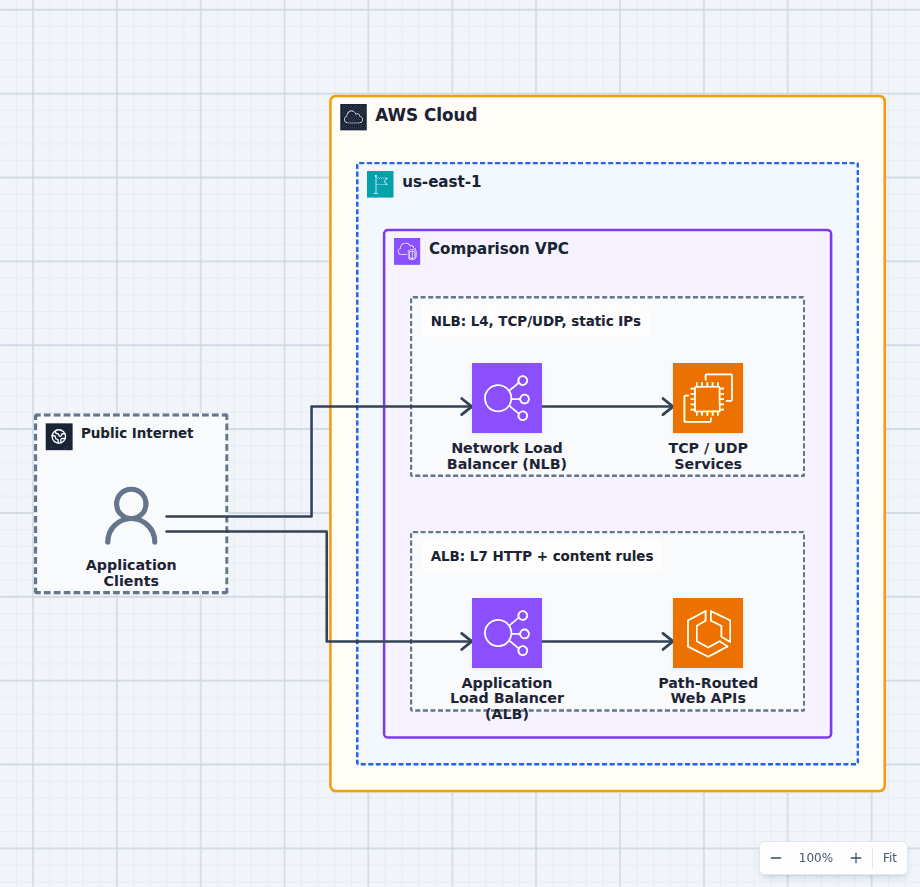
Application Load Balancer vs Network Load Balancer
Choose an ALB for HTTP applications that need content-based routing, redirects, OIDC or Cognito authentication, Lambda targets, or AWS WAF. Choose an NLB for non-HTTP protocols, static IP addresses, source-IP preservation, PrivateLink endpoint services, or extremely high connection throughput. The editable diagram keeps both paths side by side so you can preserve the one that fits your protocol and delete the other.
Explore the architecture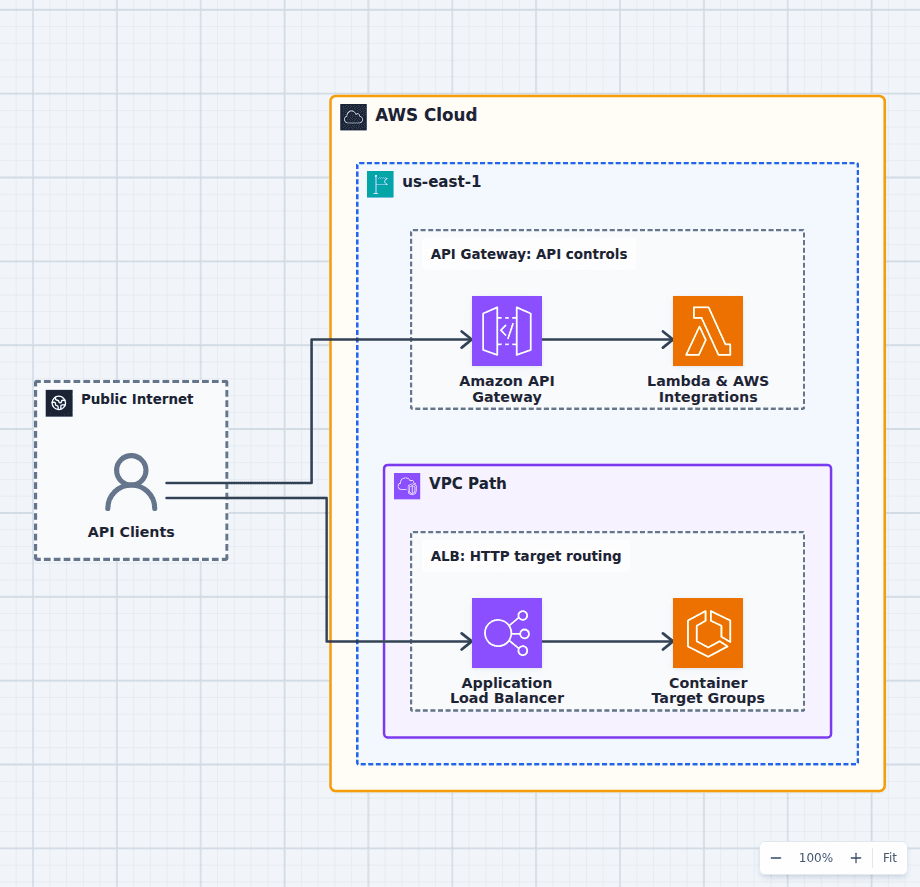
Amazon API Gateway vs Application Load Balancer
Choose API Gateway for public or partner APIs that need API keys, usage plans, authorizers, per-client throttling, stages, transformations, WebSockets, or direct service integrations. Choose ALB for high-volume HTTP routing to ECS, EKS, EC2, IP, or Lambda targets when load balancing is the main requirement. Request economics can favor ALB at sustained volume and API Gateway at small or variable scale, but features often decide first.
Explore the architecture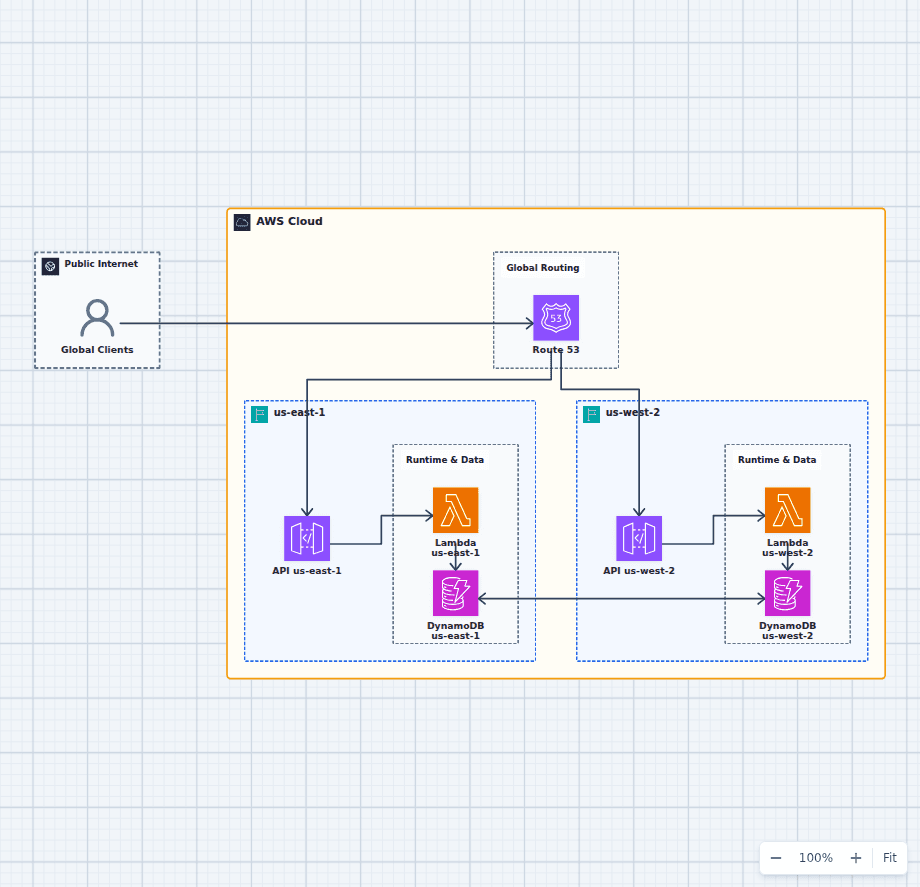
Multi-Region Serverless API on AWS
This multi-Region serverless pattern makes regional independence explicit. DNS, compute, and data behavior are separated so teams can discuss routing policy, write ownership, replication conflicts, dependency locality, failover, and failback before declaring the application regionally resilient.
Explore the architectureFrom reference to working draft
Adapt this architecture with your AWS AI Agent
Start from the exact diagram in this guide. Change requirements, challenge a decision, or ask what fails first, while keeping the architecture editable.