
AWS Lambda vs Amazon EC2
Compare per-invocation serverless functions with virtual machines for control, scaling, runtime limits, operations, and economics.
Open editable diagramArchitecture diagram
Edit this exact diagram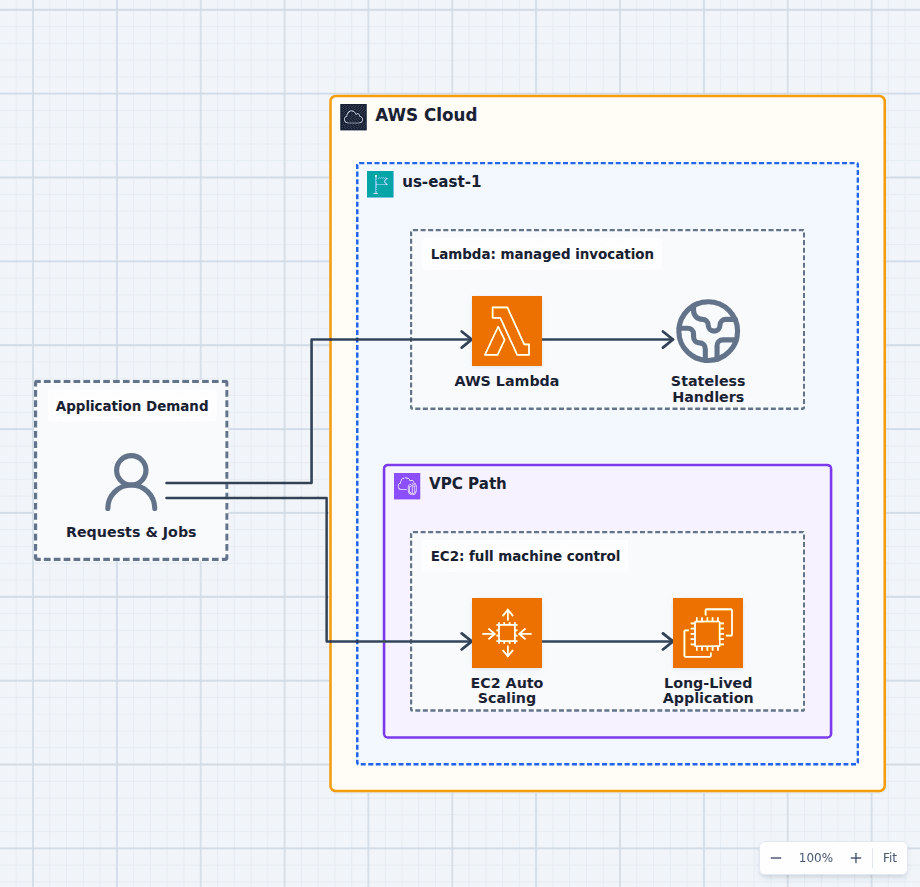 Open on the canvas
AWS Lambda vs EC2 architecture diagram comparing per-invocation serverless functions with a long-lived application on an EC2 Auto Scaling fleet. The image links to a fully editable BuildPlane starter.
Overview
AWS Lambda runs code as managed event-driven invocations; Amazon EC2 provides virtual machines the team configures and operates. Lambda removes operating-system and capacity management and scales by concurrency. EC2 exposes the full machine, process, storage, network, and lifecycle, which is necessary for some workloads and unnecessary responsibility for others.
Components
- Shared decision context: Application traffic and background work with variable duration and concurrency.
- AWS Lambda: Event-driven functions with no server fleet and automatic concurrency scaling. Short tasks that externalize durable state and finish within one invocation.
- EC2 Auto Scaling: A managed fleet of virtual machines chosen, patched, and scaled by the team. Persistent processes with custom operating systems, agents, storage, or hardware.
Comparison Flow
- Requests & Jobs can enter the AWS Lambda path and continue to Stateless Handlers.
- Requests & Jobs can instead enter the EC2 Auto Scaling path and continue to Long-Lived Application.
- Choose the path whose operating model and constraints match the workload, then delete the unused branch in the editable diagram.
Customize First
- Compare tail latency, runtime duration, dependency size, and traffic predictability.
- Include patching, images, scaling, and on-call labor in EC2 total cost.
- Split the system when APIs and background jobs have different compute shapes.
Side-by-side decision
AWS Lambda vs Amazon EC2
Use Lambda for finite stateless events and APIs. Use EC2 when the workload needs a persistent machine environment or capabilities the managed function sandbox cannot provide.
| Decision factor | AWS Lambda | Amazon EC2 |
|---|---|---|
| Unit | Function invocation | Virtual machine instance |
| Management | AWS owns OS and runtime infrastructure | Team owns OS, AMIs, patches, agents, and capacity |
| Scaling | Concurrency, including zero | Instances through Auto Scaling |
| Runtime | Finite and constrained function environment | Long-lived processes and full OS control |
| Hardware | Managed function sizes and architectures | Broad CPU, memory, GPU, storage, and network choices |
| Billing | Requests and execution resources | Instance time and attached resources |
Related AWS guides
Understand the decisions behind this diagram
Use these practical explanations to compare services, failure boundaries, and operating tradeoffs before adapting the architecture.
Design rationale
Decisions that shape this architecture
A persistent process is the dividing line
Servers, connection brokers, some game workloads, custom schedulers, appliances, and software requiring host agents naturally fit EC2. Independent events that load input, compute, write output, and finish naturally fit Lambda.
Availability is assembled differently
Lambda runs across managed infrastructure inside a Region. EC2 availability depends on the architecture: multiple instances, an Auto Scaling group, a load balancer, and multiple Availability Zones. Comparing one Lambda function with one EC2 instance creates a false availability comparison.
Operational labor belongs in the calculation
EC2 cost is not only instance price. AMI pipelines, patching, capacity, agents, security hardening, deployments, and on-call response are part of total ownership. Lambda shifts that work while introducing concurrency, cold-start, packaging, and service-limit engineering.
Before production
Operational checks
Load-test Lambda concurrency and EC2 Auto Scaling under the same demand trace.
Test deployment rollback and Availability Zone failure for both paths.
Inventory OS, agent, hardware, storage, port, and duration requirements.
Model idle time, data transfer, logging, storage, and support infrastructure.
Scope and tradeoffs
What this diagram does not solve
Containers may be the middle option
Fargate or ECS on EC2 can preserve a conventional process model while reducing some machine operations. Include that option when Lambda is too constrained and raw EC2 is more control than the team wants.
Migration requires application redesign
Moving a long-lived server into Lambda is not a deployment setting. State, background work, connections, files, retries, and request boundaries often need to be separated first.
Common questions
Frequently asked questions
Can Lambda replace every EC2 server?
No. Lambda is for event-driven units of work within its runtime model. Persistent servers, specialized hardware, host-level software, and unrestricted long-running processes still need EC2 or another container and compute service.
Does Lambda need a load balancer?
Not necessarily. API Gateway, Lambda function URLs, Application Load Balancer, and many AWS event sources can invoke Lambda. Choose the entry point from API, security, and routing requirements.
Which scales faster?
Lambda can create concurrency quickly without provisioning instances. EC2 scaling depends on launch, boot, configuration, registration, and application warm-up. Warm pools and predictive scaling can narrow the difference for predictable bursts.
Keep exploring
Related AWS architectures
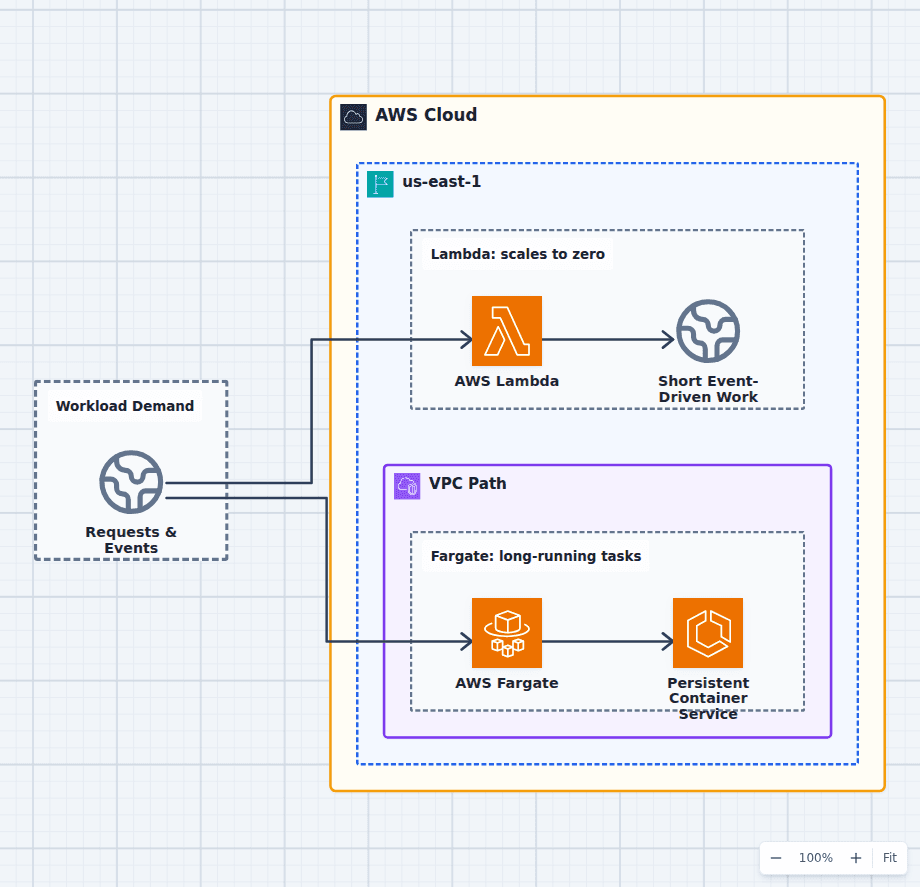
AWS Lambda vs AWS Fargate
Choose Lambda for short, stateless, event-driven work with variable traffic and a supported runtime model. Choose Fargate for long-running services, background consumers, larger dependencies, custom runtimes, persistent connections, or an existing container image. Real systems often use Fargate for the always-on API and Lambda for bursty side jobs, so the architecture need not force every workload into one compute model.
Explore the architecture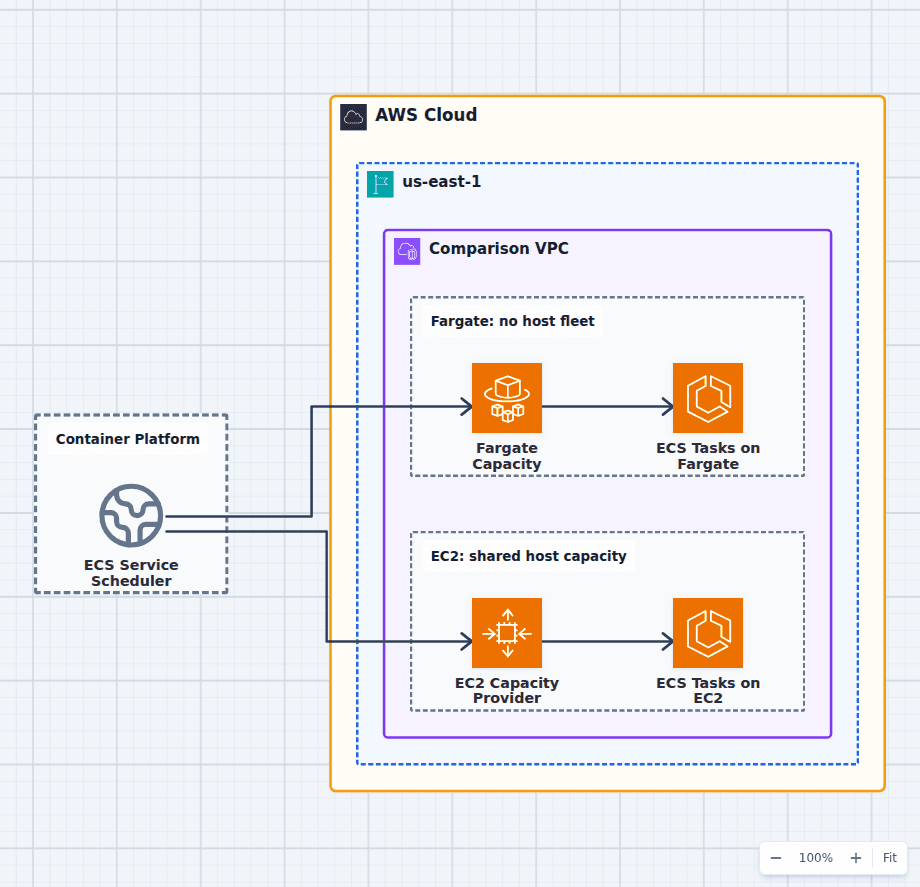
AWS Fargate vs Amazon EC2 for ECS
Choose Fargate when removing host management and isolating capacity per task matter more than the lowest steady-state unit cost. Choose ECS on EC2 when the workload needs GPUs, privileged or daemon access, specialized instances, very high sustained utilization, or deeper control over placement and networking. Capacity providers make this a per-service or mixed-cluster decision rather than an irreversible platform choice.
Explore the architecture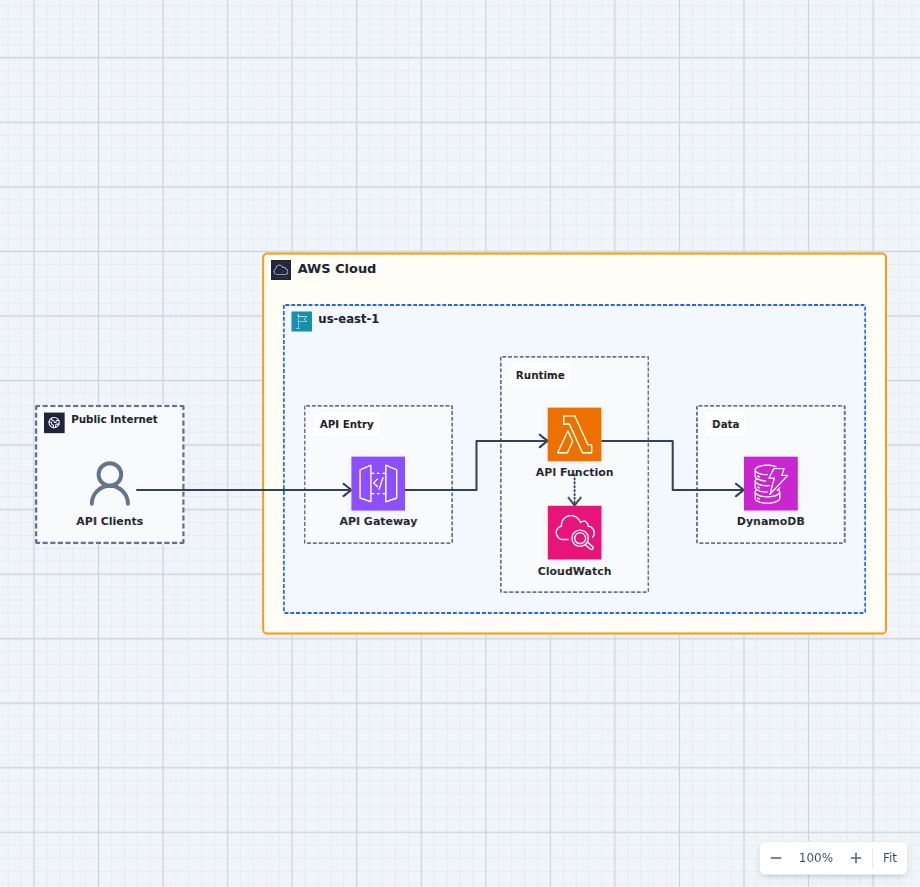
Serverless REST API Architecture on AWS
This is the serverless API baseline that most production APIs grow from rather than away from: a managed HTTPS entry point, stateless function compute, on-demand data storage, and observable execution. It is deliberately compact so the first real decisions stay legible. Adding authentication, caching, asynchronous work, and a second Region each attaches to this shape without replacing it, which is why it is worth understanding before the additions arrive.
Explore the architectureFrom reference to working draft
Adapt this architecture with your AWS AI Agent
Start from the exact diagram in this guide. Change requirements, challenge a decision, or ask what fails first, while keeping the architecture editable.