
Amazon SNS vs Amazon EventBridge
Compare high-throughput pub/sub notifications with rule-based event routing, schemas, SaaS sources, archives, and replay.
Open editable diagramArchitecture diagram
Edit this exact diagram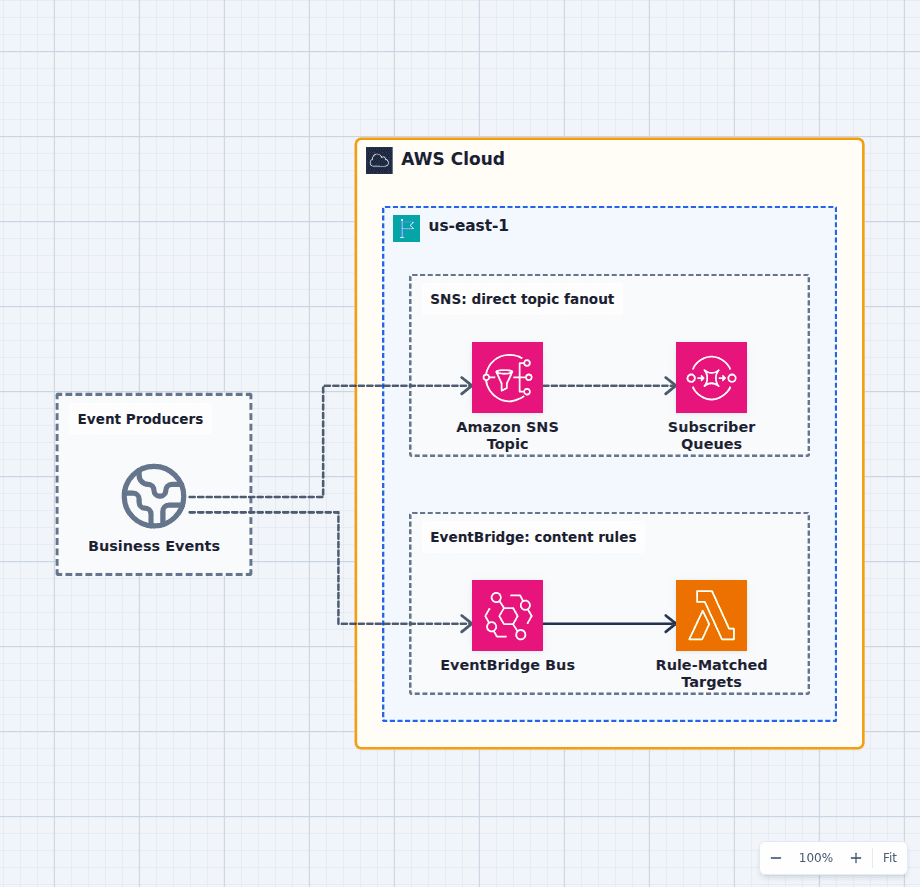 Open on the canvas
Amazon SNS vs EventBridge architecture diagram comparing topic fanout to subscriber queues with rule-based event-bus routing to selected targets. The image links to a fully editable BuildPlane starter.
Overview
Amazon SNS is a direct push-based pub/sub service optimized for fanout and endpoint notifications. Amazon EventBridge is a rule-based event router built around structured events, buses, content patterns, cross-account delivery, SaaS integrations, schemas, archives, and replay. Both can invoke AWS targets, and both commonly use SQS behind consumers that need durable buffering.
Components
- Shared decision context: Application and partner events emitted without knowing every consumer.
- Amazon SNS Topic: Pushes messages directly to subscribers with subscription filter policies. Durable per-consumer buffers for fanout delivery.
- EventBridge Bus: Matches structured events against rules and routes them across AWS, accounts, and SaaS integrations. Different targets receive only events matching their declared patterns.
Comparison Flow
- Business Events can enter the Amazon SNS Topic path and continue to Subscriber Queues.
- Business Events can instead enter the EventBridge Bus path and continue to Rule-Matched Targets.
- Choose the path whose operating model and constraints match the workload, then delete the unused branch in the editable diagram.
Customize First
- Define event ownership and versioning before adding more rules or subscribers.
- Choose EventBridge archives only for events whose replay has an operational owner.
- Use SNS for endpoint notifications and EventBridge for domain-event routing when both appear.
Side-by-side decision
Amazon SNS vs Amazon EventBridge
Use SNS for direct fanout and user or endpoint notifications. Use EventBridge for structured domain events that need rich rules, buses, cross-account routing, SaaS integration, archives, or replay.
| Decision factor | Amazon SNS | Amazon EventBridge |
|---|---|---|
| Core model | Topic and subscriptions | Event bus and rules |
| Filtering | Subscription attributes and message-body policies | Rich event-pattern matching on structured fields |
| Destinations | Queues, Lambda, HTTP/S, email, SMS, mobile | Broad AWS targets, buses, API destinations |
| Integration scope | Direct application fanout | AWS services, accounts, and SaaS event sources |
| Replay | Archive and replay options for supported topic modes | Event bus archives and controlled replay |
| Typical use | Notifications and high-throughput fanout | Domain events and integration routing |
Related AWS guides
Understand the decisions behind this diagram
Use these practical explanations to compare services, failure boundaries, and operating tradeoffs before adapting the architecture.
Design rationale
Decisions that shape this architecture
Choose from event ownership
SNS works well when one publisher owns a topic and subscribers want a copy. EventBridge works well when a domain event enters a wider routing fabric whose rules, accounts, sources, and targets evolve independently.
Filtering depth changes coupling
SNS subscription filters are effective for attributes and message bodies. EventBridge patterns are built for matching nested structured event fields. Richer central routing can reduce subscriber noise but also creates a rule catalog that needs ownership and testing.
Retention belongs behind the router or in an archive
Neither direct push model should be mistaken for a work queue. Send events into per-consumer SQS queues when processing needs backpressure, or deliberately configure archive and replay when reproducing past events is an operational workflow.
Before production
Operational checks
Version event schemas and keep consumers tolerant of additive fields.
Monitor failed invocations, dead-letter targets, rule matches, and throttling.
Test cross-account permissions and event-bus resource policies.
Assign owners to archives, replays, subscriptions, and stale routing rules.
Scope and tradeoffs
What this diagram does not solve
Throughput and quotas differ by Region and feature
Do not choose from one global number. Check current service quotas, endpoint behavior, FIFO requirements, and regional availability against the traffic model.
Complex rules can hide system behavior
EventBridge makes routing flexible, but a large undocumented rule set is harder to trace than a simple topic. Keep event catalogs, owners, and observability close to the architecture.
Common questions
Frequently asked questions
Is EventBridge a replacement for SNS?
Not universally. EventBridge is stronger for structured event routing and integration; SNS remains an excellent direct fanout and notification service. Many architectures use EventBridge for domain events and SNS for endpoint notification channels.
Can both services deliver to SQS?
Yes. An SQS queue gives either routing service a durable consumer buffer, independent retry policy, and visible backlog.
Which has better filtering?
EventBridge provides richer event-pattern matching across structured fields. SNS supports subscription filtering on message attributes and message bodies, which is sufficient for many fanout designs.
Keep exploring
Related AWS architectures
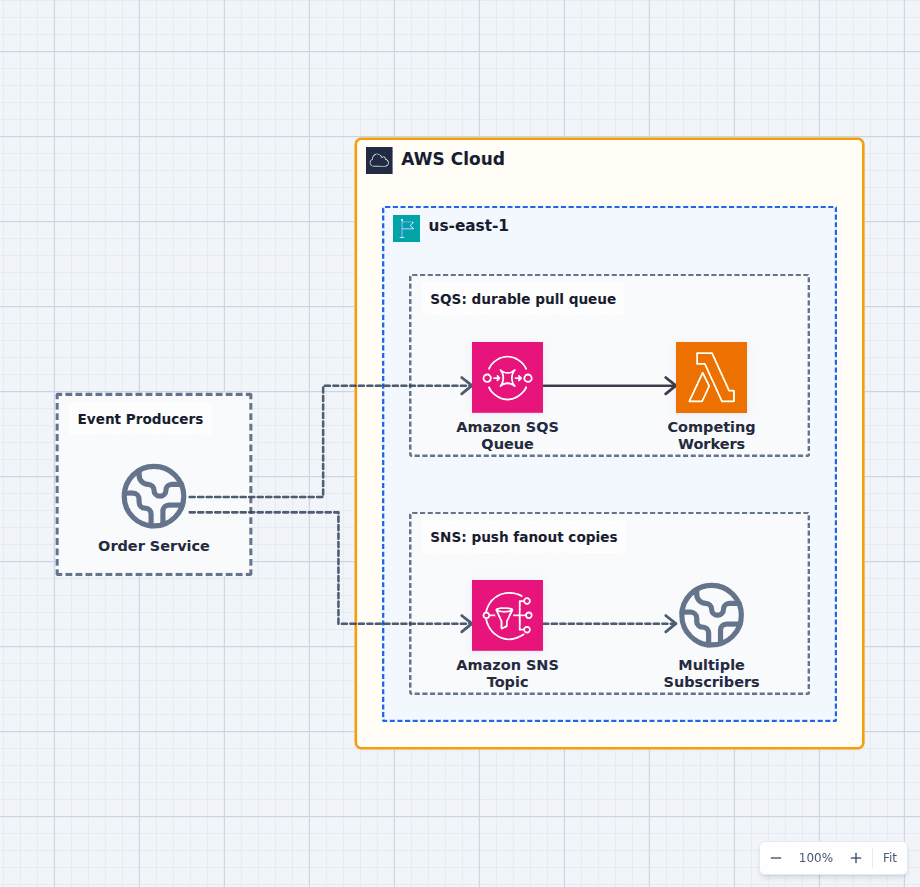
Amazon SQS vs Amazon SNS
SQS answers who should process this unit of work next; SNS answers which subscribers should receive a copy of this notification. They are commonly used together: a publisher sends one event to SNS, and each durable consumer owns an SQS subscription queue with separate retries, scaling, and a dead-letter queue. The editable comparison diagram shows the pure patterns before you combine them.
Explore the architecture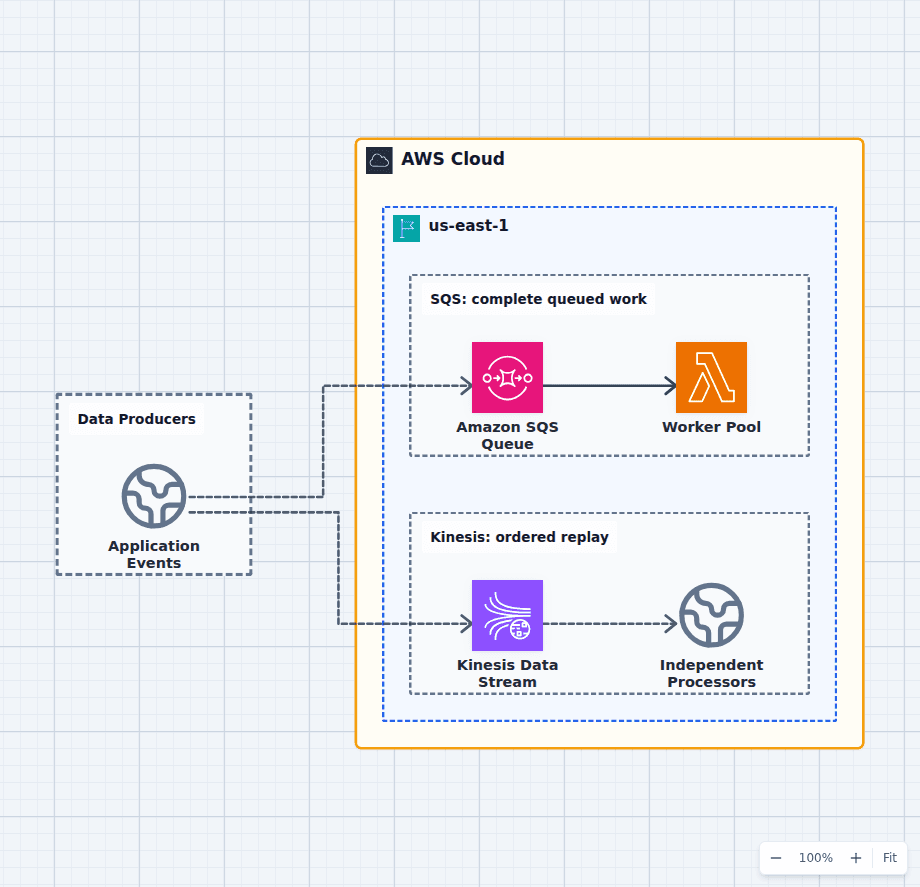
Amazon SQS vs Amazon Kinesis Data Streams
Choose SQS for jobs, commands, and asynchronous work where one consumer path should complete each message. Choose Kinesis for telemetry, clickstreams, change records, and event histories that require per-key ordering, multiple independent processors, or replay. The choice is queue semantics versus stream semantics, not simply low throughput versus high throughput.
Explore the architecture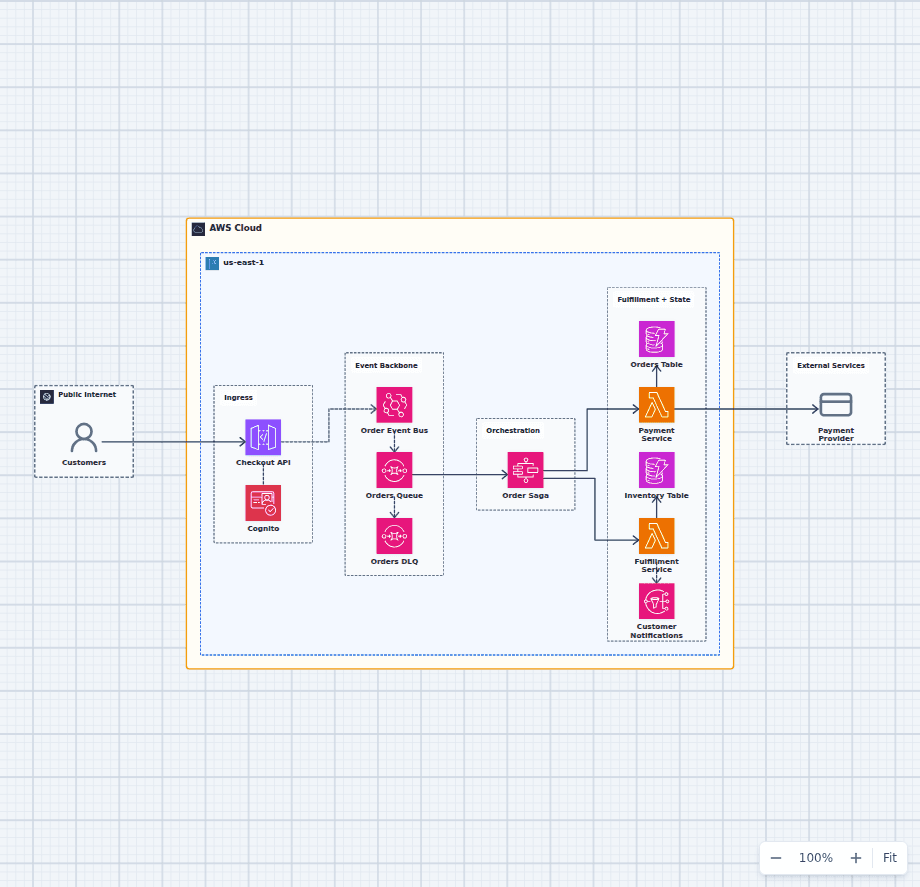
Event-Driven Order Processing Architecture on AWS
This design accepts an order through an authenticated API, publishes a durable domain event, and uses a saga to coordinate payment, inventory, fulfillment, and notification. It separates request latency from business processing while preserving explicit recovery paths.
Explore the architectureFrom reference to working draft
Adapt this architecture with your AWS AI Agent
Start from the exact diagram in this guide. Change requirements, challenge a decision, or ask what fails first, while keeping the architecture editable.